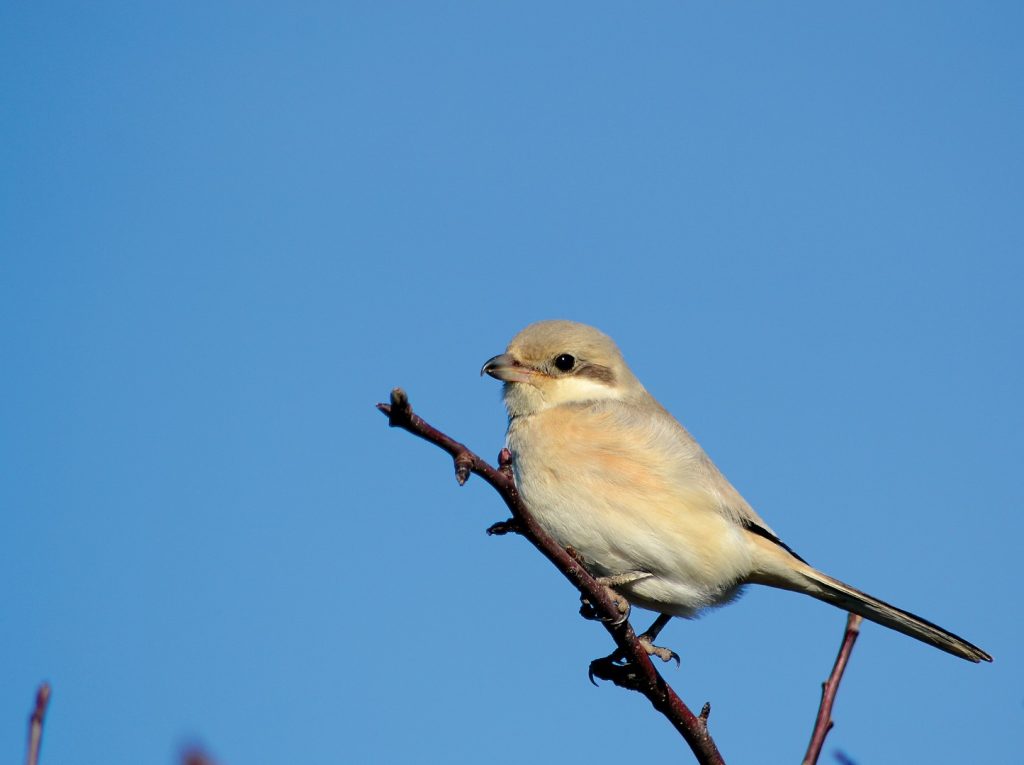
Acrocephalus bistrigiceps BLACK-BROWED REED-WARBLER.
Reedbeds, tall grass, brush, thickets, farms.
Se Siberia from e Transbaicalia e to s Amurland, Ussuriland and Sakhalin,
n Mongolia, c,e China, probably Korea, and Japan on Hokkaido and Honshu.
Acrocephalus agricola PADDYFIELD WARBLER. Open reedbeds,
sedges, rank grass, scrubby growth in swamps. S,se Russia in the
n shore region of the Black Sea and n Caspian Sea area, sw Siberia on the
upper Ob R., upper
Yenesei R. and Tuva, Azerbaijan, Kazakhstan, ne Iran, n Afghanistan
and nw China in Sinkiang and n Tsinghai; Manchuria.
The Manchurian race tangorum formerly
was treated as a species.
Acrocephalus concinens BLUNT-WINGED WARBLER. Open
reedbeds, sedges, deep grass, thickets, farms. Locally to 3000 m
in n Afghanistan, n,ne India and c China.
Acrocephalus scirpaceus EURASIAN REED-WARBLER. Reedbeds,
bushes near water, towns, farms, scrub, open forest undergrowth.
From s British Isles and s Scandinavia se across c Russia to s Russia,
n to Kirghiz steppes and Lake Zaysan (but absent between Caspian and Aral
seas and in e Turkestan), s to nw Africa from Morocco to Tunisia, n Libya
and ne Egypt, Mediterranean region incl. most islands, Turkey, Near East,
Iran, s Russia and probably w China in w Sinkiang.
Acrocephalus baeticatus AFRICAN REED-WARBLER. Reedbeds,
bushes near water, open forest undergrowth, tall grass, mangroves.
-
The relationships of this taxon are controversial and several arrangements
have been proposed, including merging it in
A. scirpaceus. Dowsett and Dowsett-Lemaire (1993, p. 358) discuss
the problem and conclude that scirpaceus and baeticatus should be merged.
They approach closely with scirpaceus breeding in the Nile delta and baeticatus
on the Red Sea coast. They differ in size but have identical songs.
However, unless intergradation occurs it is a matter of which species concept
one wishes to apply.
Locally in Mauritania, Mali, Senegambia and Niger; from Nigeria,
Cameroon, Gabon, L. Chad area, s Sudan, c Ethiopia, s Somalia, Rwanda,
Burundi, Uganda and w,c,se Kenya, Tanzania s to Zaire, Angola, Zambia,
Malawi and Mozambique; mangroves along Red Sea and Gulf of Aden coasts
from Sudan to Somalia and sw Arabia in Saudi Arabia and Yemen; locally
in s Africa in Namibia, Botswana, Zimbabwe, extreme s Mozambique and S.
Africa.
-
Acrocephalus dumetorum BLYTH'S REED-WARBLER. Marshy
vegetation, bushes near water, scrub, open forest undergrowth, tall grass,
orchards, farms. From s Finland e across nw,c Russia to c Siberia
e to upper Tunguska River
and Vilyuy R., and region w of Lake Baikal and nw Mongolia, s to s
Russia, Azerbaijan, e Iran, n Afghanistan and sw Siberia in the Altai.
Acrocephalus palustris MARSH WARBLER. Wet shrubby
thickets, riverine scrub, bushy areas, grassland, towns, farms, subalpine
meadows. From s England, s Sweden and s Finland e to c Russia e to
s Urals and extreme nw Kazakhstan, s to s France, c Italy, n Greece, n
Black Sea area, e Turkey, nw Iran and on the nw,n shores of the Caspian
Sea.
Acrocephalus arundinaceus GREAT REED-WARBLER. Reedbeds,
brush near water.
The two groups sometimes are treated as species; they seem to be allopatric.
B. King (pers. comm.) recommends species status for orientalis.
A. a. arundinaceus From continental Europe and s
Sweden e across c Russia to sw Siberia in the Altai, and from extreme w
China in w Sinkiang, s to nw Africa from Morocco to Tunisia, Mediterranean
incl. most islands, Turkey, n Israel, n Iran, s Russia, Turkestan (absent
from Turkmenia).
A. a. orientalis From c,e China, se Siberia in s
Transbaicalia, Amurland, Ussuriland and Sakhalin, Korea and Japan on Hokkaido,
Honshu, Shikoku and Kyushi.
Acrocephalus stentoreus CLAMOROUS REED-WARBLER. Reedbeds,
papyrus swamps, mangroves, lantana thickets, towns.
-
There may be more than one species involved among these allopatric
populations. A. orinus, based on a unique specimen from n India,
may be a molting individual of stentoreus. B. King (pers. comm.)
suggests that orinus is a separate species.
A. s. stentoreus From n,c Egypt, extreme s Israel,
coastal Sudan, Eritrea, Somalia and Arabia (exc. nw,c) e across e,s Iran
and from se shore of Aral Sea se to Transcaspia and Turkestan, e through
Afghanistan and Pakistan to w,sw,n India and locally s over peninsular
India in Rajasthan, Kerala and W. Bengal; Sri Lanka; s China, c,e Burma,
w Java, Lesser Sunda is. of Lombok, Sumbawa and Sumba, the Moluccas incl.
Buru; Philippines on Luzon, Mindoro, Leyte, Bohol and Mindanao; Bismarck
Arch., Solomon Is., and extreme ne Australia in Queensland.
A. s. celebensis S Sulawesi.
-
Acrocephalus griseldis BASRA REED-WARBLER. Reedbeds.
S Iraq along the Lower Euphrates and Tigris rivers. May be a race
of stentoreus.
Acrocephalus australis AUSTRALIAN REED-WARBLER.
Reedbeds, lantana thickets, bamboo, towns. Australia, Tasmania (absent
from n Queensland); New Guinea, Bismarck Archipelago and Solomon Is.
Acrocephalus luscinia NIGHTINGALE REED-WARBLER.
Reedbeds, thickets, forest undergrowth. Mariana Is. of Agrihan, Alamagan,
Saipan and Aguijan; extinct on Guam and probably on Pagan.
The reed-warblers of the tropical Pacific are variously combined into
broader species; the arrangement here reflects variation in their vocal
behavior.
Acrocephalus syrinx CAROLINE ISLANDS REED-WARBLER.
Tall grass, second-growth, forest, towns. Caroline Islands.
Acrocephalus rehsei NAURU REED-WARBLER. Brushy areas.
Island of Nauru.
Acrocephalus familiaris MILLERBIRD. Dense low vegetation,
grass, brush. Nihoa I. in the w Hawaiian Is.; extinct on Laysan since
before 1923.
Acrocephalus aequinoctialis BOKIKOKIKO. Dense brush.
N. Line Is. of Teraina, Tabuaeran, Kiritimati.
Acrocephalus caffer TAHITI REED-WARBLER. Bamboo, thickets,
second-growth. Moorea and Tahiti in the Society Is.
Acrocephalus mendanae MARQUESAN REED-WARBLER. Brush,
wet forest, woods. Lowlands to 1200 m in the Marquesas Is.
Acrocephalus atyphus TUAMOTU REED-WARBLER. Brushy
forest. Tuamotu I.
Acrocephalus kerearako COOK ISLANDS REED-WARBLER.
Reeds, woods, brush, towns. Mitiaro and Mangaia islands in
the Cook Is.
Acrocephalus rimatarae RIMATARA REED-WARBLER. Brushy
forest, reedbeds. Rimatara I. in the Tubuai Is.
Acrocephalus vaughani PITCAIRN REED-WARBLER. Brushy
forest, reedbeds. Pitcairn I. in the c Pitcairn Is.
Acrocephalus taiti HENDERSON ISLAND REED-WARBLER.
Brushy forest, reedbeds. Henderson I. in the sw Pitcairn Is.
Acrocephalus rufescens GREATER SWAMP-WARBLER. Reedbeds,
papyrus swamps, high swamp grass. Mauritania, Mali, Senegambia; from
Ghana, Togo, s Nigeria, Gulf of Guinea Is., s Cameroon, Gabon, Congo, C.
African Rep., Chad, Sudan, n,e Zaire, Rwanda, Burundi, Uganda and w Kenya
s to n,e Angola, n,e Botswana, Namibia, Zimbabwe, n Zambia and w Tanzania.
Acrocephalus brevipennis CAPE VERDE SWAMP-WARBLER.
Swampy vegetation, bamboo, towns, woods. Cape Verde Is. of São
Nicolau, São Tiago and Brava.
Acrocephalus gracilirostris LESSER SWAMP-WARBLER.
Reedbeds, papyrus swamps, high swamp grass. Locally in Nigeria; c
Angola, Zambia, se,e,ne Zaire, Chad, se Sudan, n,c Ethiopia, s Somalia,
Rwanda, Burundi, Uganda, w,c,se Kenya s (exc. arid sw), Tanzania, Malawi,
Mozambique, Botswana, Zimbabwe, Namibia and to s S. Africa.
Acrocephalus newtoni MADAGASCAR SWAMP-WARBLER. Reedbeds,
papyrus swamps, high swamp grass, mangroves. Lowlands to 1800 m of
Madagascar.
Acrocephalus aedon THICK-BILLED WARBLER. Reedbeds,
thickets near water, riparian vegetation. S Siberia from upper Ob
R. e across Transbaicalia to w Amurland and Ussuriland, n Mongolia and
ne China from Heilungkiang s to w Inner Mongolia, n Hopeh and Liaoning.
-
The two following species have been placed in Bebrornis,
but F. Dowsett-Lemaire (1994. Ibis 136:489-491) compared the songs of A.
newtoni, A. brevipennis, A. gracilirostris, A. rufescens, A. rodericanus
and A. sechellensis.
She concluded that these species are closely related and form the subgenus
Calamocichla, the members of which differ from the other species of Acrocephalus
in being plain-plumaged, strong-legged and sedentary.
Unpublished DNA sequence studies by K. Schulze-Hagen were cited in
support of a close relationship among gracilirostris, newtoni and sechellensis.
-
Acrocephalus rodericanus RODRIGUEZ BRUSH-WARBLER.
Open scrubby woods. Rodrigues I. in the e Mascarene Is. Rare,
population reduced.
Acrocephalus sechellensis SEYCHELLES BRUSH-WARBLER.
Open scrubby woods, swamp, bamboo. Cousin I. in the Seychelles Is.
Population ca. 85 individuals.
Greenish-brown above; yellowish below, some with streaks; tail long,
graduated, white-tipped. Food insects taken on foliage and by flycatching;
possibly other small animals. Nest a neat cup of fibers and grass,
in a fork. Eggs 1-2, whitish with green and brown speckles.
Hippolais: Warblers. Woods, scrub, gardens, often
near water. Eurasia, n Africa.
There is little morphological evidence to separate Hippolais from Acrocephalus
and DNA hybridization data support that view (Sibley and Ahlquist 1990:866,
fig. 381).
11-15.5 cm Plumages similar to Acrocephalus: Brownish-olive,
buffy or grayish above; whitish below with whitish lores and supercilium
or yellowish lores and underparts in polyglotta, icterina; tail square.
Food insects. Nest a cup of twigs, grass, stems, hidden in dense
vegetation near the ground; eggs 3-5, variable: pinkish white to gray with
gray, purple, black spots, lines, blotches.
Hippolais caligata BOOTED WARBLER. Gardens,
hedgerows, canebrakes, scrub, bushes, usually near water. From nw,c
Russia e to w Siberia (upper Yenisei River) and nw Mongolia, s to e of
the Caspian Sea and n of the range of H. rama, and extreme w China in w
Sinkiang.
Hippolais rama SYKE'S WARBLER. From ne Arabia in
nw Oman, s,e Iran, Afghanistan, and from Transcaspia e to Turkestan and
probably Pakistan. Often treated as a race of H. caligata.
Hippolais pallida OLIVACEOUS WARBLER. Arid areas
with trees and shrubs, usually near water. Spain, n Africa from Mauritania
e to Egypt, and from the Balkan states n to s Hungary and s Romania, s,e
to Turkey, Near East and Saudi Arabia e to Iraq, w,n Iran, Caucasus, from
Transcaspia n to Aral Sea, s Kazakhstan and Turkestan and probably w China
in w Sinkiang; oases in the Sahara in Niger, Lake Chad area, c Sudan around
Khartoum and Djibouti; w Africa in Senegal, Nigeria and Cameroon.
Hippolais languida UPCHER'S WARBLER. Gardens, vineyards,
bushes, open woods, scrub, semi-desert. From s Turkey and Near East
e through the Caucasus, Transcaspia, Turkestan, n Iraq, w,s Iran and n
Afghanistan to nw Pakistan in n Baluchistan.
Hippolais olivetorum OLIVE-TREE WARBLER. Gardens,
orchards, olive groves, oaks. In s Yugoslavia, s Romania, Bulgaria,
Greece, w,s Turkey, Crete, Cyprus, probably Near East, and n Iran.
Hippolais polyglotta MELODIOUS WARBLER. Woodland,
dense shrubs esp. along water, scrub, forest edge, forest steppes, towns,
orchards. From sw Europe n to n,e France (exc. Brittany), sw Switzerland,
n Italy, Sicily, Corsica; nw Africa from Morocco to Tunisia.
Hippolais icterina ICTERINE WARBLER. Woodland, scrub,
forest edge, towns, orchards.
From continental Europe w to e France and s Scandinavia se across c
Russia to sw Siberia (upper Ob R., Altai), and s to n Italy, n Yugoslavia,
Bulgaria, nw Turkey and n Black Sea area; Caucasus, cn Iran.
-
Chloropeta: Flycatcher-Warblers. Mts., Africa.
Above yellow and olive-brown or greenish; yellow below. The species
of Chloropeta have been allied to the muscicapine flycatchers by some authors.
C. gracilirostris has been placed in Calamonastides and viewed as more
closely related to the swamp-warblers, Calamocichla = Acrocephalus.
Food insects. Nest a bulky, deep cup of grass, moss, bark; slung
between stems or in a fork; eggs 2-4, whitish, with or without, rusty-colored
spots, streaks.
-
Chloropeta natalensis YELLOW FLYCATCHER-WARBLER.
Open brushy areas. Locally in highlands from se Nigeria, s Cameroon,
Gabon, Congo, C. African Rep., s,e,ne Zaire, extreme se Sudan, w,c Ethiopia
and w,c Kenya, Uganda, Rwanda and Burundi s to Tanzania, Malawi, Mozambique,
Angola, Zambia, e Zimbabwe and e S. Africa in e,s Transvaal, Swaziland,
e Natal and extreme e Cape Province.
Chloropeta similis MOUNTAIN FLYCATCHER-WARBLER.
Forest, bamboo. Mts. in e Zaire, se Sudan, Uganda, w,c Kenya, Rwanda,
Burundi, Tanzania, Zambia and n Malawi.
Chloropeta gracilirostris THIN-BILLED FLYCATCHER-WARBLER.
Marshes. Locally in ne Zaire, w Uganda, Rwanda, Burundi, w Kenya
and cn Zambia.
-
Orthotomus: Tailorbirds. Forest, woods, thickets,
mangroves. Ne Africa; s,se Asia; Philippines; Java, Lombok.
10-13 cm. Small, slim, carry tail erect. Males of most species
have orange-rufous crowns; greenish, olive or gray above; face white, gray,
orange-rufous; throat white, gray; white, buffy, yellow or gray below,
including crissum; tail graduated, usually olive or brownish with white
tips; tail orange-rufous in sericeus. O. nigriceps: head, throat
black; cinereiceps: head, throat black, ear coverts white. Females
similar with less extensive brightly-colored areas. Food mainly small
insects and larvae.
The structure of the nest is the basis for the English name,
Tailorbird. The nest is built in a cavity formed of two or more large,
drooping leaves which are sewed together along the edges with threads of
plant down to form a cone or bag. The upper portion of the leaf nearest
the stem arches over the nest opening. The nest is a cup of soft
fibers, spider egg sacs and plant down, placed within the leaf cone.
In arid country where the plants have narrow leaves, several leaves may
be sewn together and the nest formed as a cup stitched to them for support,
similar to the nests of Cisticola species. Eggs 3-5, variable; usually
white to pinkish or white tinged with green or blue, or bright blue; all
spotted and marked with reddish-brown.
Orthotomus metopias AFRICAN TAILORBIRD. Forest undergrowth.
Mts. in e,s Tanzania and extreme n Mozambique. Has been placed in
Camaroptera.
Orthotomus cuculatus MOUNTAIN TAILORBIRD. Open woods,
pine forest, grass and bamboo jungle, second growth, forest edge.
Lowlands and mts. to 2500 m in e India w to e Nepal, Sikkim, Bhutan and
Bangladesh, s China, Burma (exc. c), nw,pen. Thailand, Indochina (exc.
se), Malaya; mostly in mts. of the Greater Sunda Is., Bali and Flores is.,
Moluccas on Bacan and Buru and Philippines on Luzon, Palawan and Mindanao.
Orthotomus heterolaemus RUFOUS-HEADED TAILORBIRD.
Woods, forest edge. Mt. Apo and Mt. Katanglad on Mindanao in the
s Philippines. Sometimes included in O. cuculatus.
Orthotomus sutorius COMMON TAILORBIRD. Gardens, thickets,
bamboo, second growth. Lowlands to 1500 m from Pakistan, India, Sri
Lanka and s China from w,s Yunnan to Hainan, s through se Asia; Java.
Orthotomus atrogularis DARK-NECKED TAILORBIRD. Forest
undergrowth, thickets, dense scrub. Lowlands to 1800 m from e India
w to Sikkim, n W. Bengal and Bangladesh and s China from s Yunnan to Kwantung,
s through se Asia (exc. w,c Burma); Sumatra and most adj. islands; N. Borneo
and Anambas Islands.
Orthotomus castaneiceps PHILIPPINE TAILORBIRD. Forest
undergrowth, edge, thickets, second growth. Lowlands of n,c Philippines
on n,c Luzon, Masbate, Ticao, Guimaras, Panay, Bantayan and Negros.
Orthotomus frontalis RUFOUS-FRONTED TAILORBIRD. Forest
undergrowth, thickets. Lowlands of the s Philippines on Samar, Calicoan,
Leyte, Bohol, Dinagat, Siargao, Mindanao and Basilan.
Orthotomus derbianus GREY-BACKED TAILORBIRD. Forest
undergrowth, edge, thickets, second growth.
N,sw Philippines on Luzon, Catanduanes and Palawan.
Orthotomus sericeus RUFOUS-TAILED TAILORBIRD. Scrub,
second growth, mangroves. Lowlands of Malay Pen., Sumatra, Riau and
Lingga arch., Belitung, Borneo, Natuna Is. and sw Philippines on the Calamian
Is., Palawan, Balabac and Cagayan Sulu.
Orthotomus ruficeps ASHY TAILORBIRD. Mangroves,
scrub, second growth. Lowlands to 1000 m, but mostly coastal, on
the Malay Pen., Sumatra, Mentawai Is., Riau Arch., Bangka and Belitung,
Java and Karimunjawa I., Borneo; and Cagayan Sulu in the sw Philippines.
Orthotomus sepium OLIVE-BACKED TAILORBIRD. Scrub,
mangroves. Lowlands in interior Java and small adj. islands, and
w Lesser Sunda islands of Bali and Lombok.
Orthotomus samarensis YELLOW-BREASTED TAILORBIRD.
Riparian vegetation in forest and edge. C Philippine islands of Samar,
Leyte and Bohol.
Orthotomus nigriceps BLACK-HEADED TAILORBIRD. Riparian
vegetation in forest and edge. S Philippine islands of Dinagat, Siargao
and Mindanao.
Orthotomus cinereiceps WHITE-EARED TAILORBIRD. Forest,
edge, thickets, second growth. S Philippine islands of Mindanao and
Basilan.
Eremomela: Eremomelas. Woods, savanna, scrub.
Sub-Saharan Africa.
9-12 cm. Most species are grayish, brownish or greenish above;
with or without a pale supercilium; dusky to black eye stripe; brownish
or yellow/white below; crissum yellow/white; tail short. E. badiceps
has a rufous crown and black pectoral band; usticollis a rusty pectoral
band, often pale or absent; icteropygialis has a narrow white eyering.
Food insects. Nest a cup of grass, cobwebs, leaves, slung from the
rim between two twigs or in a fork; eggs 1-3, white, grayish, pale blue,
bluish-green, with reddish/blackish spots and gray undermarks.
Eremomela icteropygialis YELLOW-BELLIED EREMOMELA.
Acacia steppe, savanna, brachystegia woodland, bushy areas. Dowsett
and Dowsett-Lemaire (1993, p. 358) "are convinced" that salvadorii is a
race of E. icteropygialis.
E. i. icteropygialis. Senegambia, s Mauritania, s Mali,
Burkina Faso, Ghana, s Niger, n Nigeria, Cameroon, Congo, s Chad and s
Sudan to Ethiopia, Eritrea, Somalia, Rwanda, Uganda, Kenya, Tanzania, Malawi,
Mozambique, Zimbabwe, Botswana, Namibia and S. Africa, except seacoast
and high grasslands.
E. i. salvadorii SALVADORI'S EREMOMELA. Woodland,
forest. Highlands in sw,sc Zaire, Angola and w Zambia.
Eremomela flavicrissalis YELLOW-VENTED EREMOMELA.
Dry acacia scrub. Ne Uganda, s Ethiopia, s Somalia, n,ec,se Kenya.
Eremomela pusilla SENEGAL EREMOMELA. Savanna.
Senegambia, s Mauritania, s Mali, Guinea, Burkina Faso, Sierra Leone, Ivory
Coast, Ghana, Togo, Benin, Nigeria, extreme s Niger, w Cameroon, Lake Chad
area, n C. Afr. Rep.
Eremomela canescens GREEN-BACKED EREMOMELA. Savanna.
From e Cameroon, s Chad and C. African Rep., e across s Sudan, n,ne Zaire
and Uganda to w,c Ethiopia and w Kenya. Occasional hybrids with pusilla
in s Chad. The East African List Committee place canescens in pusilla
(D. A. Turner, pers. comm.).
Dowsett and Dowsett-Lemaire (1993, p. 358) also include canescens in
pusilla, but express reservations and note that further investigation is
warranted. Vocalizations are said to differ.
Eremomela scotops GREENCAP EREMOMELA. Savanna, brachystegia
woodland. From Gabon, Congo, sw,sc,ec Zaire, Rwanda, Burundi, s Uganda,
s Kenya and Tanzania s to s Angola, ne Namibia (Caprivi), n Botswana, Zambia,
Malawi, Zimbabwe, Mozambique and e S. Africa in Transvaal and Natal.
Eremomela gregalis YELLOW-RUMPED EREMOMELA. Arid
karoo scrub. Wc,sw Namibia and w,c Cape Prov. in w S. Africa.
Eremomela badiceps RUFOUS-CROWNED EREMOMELA. Forest.
Sierra Leone, se Guinea, Liberia, Ivory Coast, Ghana, Togo, Nigeria to
s Cameroon, Gulf of Guinea Is., Equatorial Guinea, Gabon, Congo, n,ne Zaire,
extreme s Sudan and nw Uganda, s to nw Angola and sw,sc,ce Zaire.
Eremomela turneri TURNER'S EREMOMELA. Forest.
Locally in ce Zaire, sw Uganda and w Kenya in the Kakamega Forest.
Eremomela atricollis BLACK-NECKED EREMOMELA. Brachystegia
woods. Angola (exc. nw,s), Zambia and se Zaire.
Eremomela usticollis BURNT-NECK EREMOMELA. Acacia.
S Angola, n,c Namibia, Botswana, Zambia, Malawi, Zimbabwe, w Mozambique
and e S. Africa in Transvaal and e Natal.
Randia pseudozosterops RAND'S WARBLER. Rain forest
canopy. Mts., 800-1500 m, of e Madagascar.
Affinities uncertain. 12 cm. Gray above; grayish-brown below;
lores, supercilium white; cheeks, chin whitish; tail gray-brown; bill long,
thin.
Newtonia: Newtonias. Madagascar. Known from
few specimens; affinities uncertain.
Food insects; nesting unknown.
Newtonia amphichroa DARK NEWTONIA. Rain forest, second
growth. Highlands, 500-1800 m of e Madagascar.
Newtonia brunneicauda COMMON NEWTONIA. Forest, woods,
mangroves, brush, semi-desert. Lowlands and mts. to 2200 m of Madagascar.
Newtonia archboldi ARCHBOLD'S NEWTONIA. Subarid
scrub. Sea level to 2000 m of s,sw Madagascar.
Newtonia fanovanae RED-TAILED NEWTONIA. Rain forest.
E,se Madagascar. Known from a single specimen taken in 1931 and rediscovered
in the field in 1989.
Sylvietta: Crombecs. Semiarid savanna, thornbush or wooded
habitats of Africa.
10-12 cm. Short-tailed, appearing tailless; gray, brown, olive-green
above; whitish, yellow, buffy, pale rufous below; some with pale supercilium;
ruficapilla has dark rufous ear coverts and rufous breast patch; whytii
pale orange-rufous face and flanks; rufescens pale rufescent below.
Food insects. Nest an open bag or purse of grass, plant down, decorated
with cobwebs, bark, leaves, flowers, etc., suspended from a branch.
Eggs 2-3, white to yellowish with greenish-gray, brown spots/markings.
Sylvietta virens GREEN CROMBEC. Forest. Senegambia,
s Mali, se Guinea, Sierra Leone, Liberia, Ivory Coast, Ghana, Togo, Benin,
sw Nigeria; from se Nigeria, s Cameroon, Gabon, Congo, C. African Rep.,
s Sudan, n,ne Zaire, Uganda and w Kenya to nw,cw Angola and sw,sc,ce Zaire
and extreme nw Tanzania.
Sylvietta denti LEMON-BELLIED CROMBEC. Forest.
Locally in Guinea, Sierra Leone, Liberia, Ivory Coast, s Ghana, Nigeria,
s Cameroon, Gabon, Congo and n,ne,ce,sc Zaire.
Sylvietta chapini CHAPIN'S CROMBEC. Forest.
Plateau region, ca. 1500 m, of ne Zaire. Sometimes treated as a race
of S. leucophrys. Considered a "dubious species" (D. A. Turner, pers.
comm.) and considered a race of leucophrys by Dowsett and Dowsett-Lemaire
(1993, p. 358), who note that "Further field investigation is needed before
accepting that this form is undoubtedly a good species". The question
is -- are the two in contact and intergrading, or allopatric?
Sylvietta leucophrys WHITE-BROWED CROMBEC. Forest.
Mts. in e Zaire, Rwanda, Burundi, Uganda, w,c Kenya and w Tanzania.
May, or may not, include chapini.
Sylvietta brachyura NORTHERN CROMBEC. Thorn scrub,
woods. Senegambia, s Mauritania, s Mali, Burkina Faso, s Niger, Guinea,
Sierra Leone, Ivory Coast, Ghana, Togo, Benin, Nigeria, Cameroon, C. Afr.
Rep., s Chad and s Sudan to Ethiopia, Eritrea, Djibouti, n,s Somalia, n,ne
Zaire, Uganda, Kenya and extreme ne Tanzania.
Sylvietta philippae SHORT-BILLED CROMBEC. Dense
acacia thickets in arid semi-desert. Ne Africa in extreme e,se Ethiopia
and Somalia.
Sylvietta ruficapilla RED-CAPPED CROMBEC. Brachystegia
woodland. In Congo, s Zaire, Angola (exc. se), Zambia, sw Tanzania,
Malawi, extreme nw Zimbabwe and nw Mozambique.
Sylvietta whytii RED-FACED CROMBEC. Forest edge,
woods, acacia savanna. Se Sudan and sc Ethiopia s through Uganda,Rwanda,
Burundi, Kenya, Tanzania and Malawi to Zimbabwe and Mozambique.
Sylvietta isabellina SOMALI CROMBEC. Acacia steppe.
E,s Ethiopia, Somalia and Kenya (except w).
Sylvietta rufescens CAPE CROMBEC. Arid scrub, moist
woods, brachystegia woodland.
The two subspecies have been treated as species, but apparent intermediates
have been reported.
S. r. ansorgei W Angola.
S. r. rufescens In s Angola, Namibia, Botswana,
Zambia, Zimbabwe, se Zaire, sw Tanzania, Burundi, Malawi and Mozambique
(exc. ne) to s S. Africa.
Hemitesia neumanni NEUMANN'S WARBLER. Forest undergrowth.
Mts. above 1350 m of ce Zaire, Rwanda and 1600-2300 m in the Impenetrable
Forest of sw Uganda.
Macrosphenus: Longbills. Also called Bush-Warblers,
Bush-creepers. Forest, edge, thickets. Central Africa
Small (11-12 cm); long, straight bill; feathers of back and rump puffed
up in life. Feed on insects gleaned from foliage. Nest unknown.
Macrosphenus kempi KEMP'S LONGBILL. Forest.
Sierra Leone, se Guinea, Liberia, Ivory Coast, Ghana and sw Nigeria.
Dowsett and Dowsett-Lemaire (1993, p. 358-9) support kempi and flavicans
as separate species.
Macrosphenus flavicans YELLOW LONGBILL. Forest.
Up to 1200 m in se Nigeria, s Cameroon, Bioko I., Gabon, Congo, nw Angola,
Zaire (exc. se), C. Afr. Rep., extreme s Sudan and Uganda.
Macrosphenus concolor GREY LONGBILL. Open forest,
second growth. Se Guinea, Sierra Leone, Liberia, Ivory Coast, Ghana,
Togo, Benin, Nigeria, Gulf of Guinea Is., s Cameroon, sw C. African Rep.,
n,ne Zaire and Uganda, s to Equatorial Guinea, Gabon, Congo and sw,sc,ce
Zaire.
Macrosphenus pulitzeri PULITZER'S LONGBILL. Forest.
Lowlands of cw Angola.
Macrosphenus kretschmeri KRETSCHMER'S LONGBILL.
Forest edge, coastal scrub. Lowlands of extreme se Kenya, c,e Tanzania
and ne Mozambique.
Has been assigned to Suaheliornis or Phyllastrephus in the Pycnonotidae
(bulbuls), but seems to be a typical Macrosphenus.
Amaurocichla bocagii BOCAGE'S LONGBILL. Forest.
São Tomé I. in the Gulf of Guinea, off w Africa.
D. A. Turner (pers. comm.) "would not place this unique São Tomé
endemic in the Sylviidae. Maybe a timaliid?"
The DNA hybridization evidence shows that the babblers (Timaliini)
are sylviids.
Hylia prasina GREEN HYLIA. Forest, woods, second-growth.
Senegambia, s Mali, Guinea-Bissau, Guinea, Sierra Leone, Liberia, Ivory
Coast, Ghana, Togo, Nigeria, Cameroon, Fernando Po I., Equatorial Guinea,
Gabon, Congo, C. African Rep., n,ne Zaire, se Sudan, Uganda, nw Kenya,
s to wc,nw Angola, sc,ce Zaire and nw Tanzania.
Affinities uncertain; has been placed in the Nectariniidae, Sylviidae
and monotypic Hyliidae.
11.5 cm. Dark olive-green above; grayish-olive below; broad greenish
or yellowish-white supercilium. Nest a large, globular or oval structure
of plant down, cobwebs,fibers, dead leaves, with a side opening near the
top; placed in vertical forks of raphia palms, bushes, or similar sites.
Eggs 1-2, plain white.
Leptopoecile: Tit-Warblers. Himalayas of India, Tibet,
China. Food insects. Nest a domed ball or oval of moss, plant
down, fur, feathers, grass, bound with cobwebs and decorated with lichens
and cocoons; placed low in a bush. Eggs 4-6, white with rufous spots.
Leptopoecile sophiae WHITE-BROWED TIT-WARBLER. Dwarf
juniper scrub, riparian thickets. Himalayas, 3000-5000 m in Turkestan,
n,ne India in Kashmir, Sikkim and n Bhutan, Tibet, w,nc China.
Leptopoecile elegans CRESTED TIT-WARBLER. Conifers,
dwarf juniper scrub. Himalayas, 3400-4300 m of nc,c China in
s Kansu, e Tsinghai, Tibet and Szechwan.
Phylloscopus: Leaf-Warblers, Woodland-Warblers, Chiffchaffs,
Warblers. Forest, woods, shrubs, thickets. Eurasia, Africa,
Melanesia; breeding range of the Arctic Warbler extends to w Alaska.
9-12.5 cm. Sexes alike in plumage; immatures not obviously different
from adults. Small, slim birds, usually in trees or bushes.
Plumages of many species virtually identical; field identification based
mainly on song, habitat and geographic distribution. Above greenish,
brownish or gray; below whitish, yellow or buffy. Head with a superciliary
line, whitish, dusky, rusty, yellowish, rarely orange; usually a dusky
to blackish stripe through the eye. Coronal bands and/or a central
crown stripe in a few species. Wings often with one or two bars;
white, yellow, rarely orange. Tail usually like back, some with white
outer webs to some rectrices or a white apical spot. Food insects,
spiders, other small invertebrates, rarely seeds, fruit. Nest a domed
structure with a side entrance; on, or near, the ground; of leaves, moss,
grass, twigs. Eggs 4-9, usually 5-7; unmarked white or white with
varying amount of rufous/brown spots.
Phylloscopus laetus RED-FACED WOODLAND-WARBLER. Forest.
Mts. 1200-3250 m in ne Zaire, w Uganda, Rwanda and Burundi.
Phylloscopus laurae LAURA'S WOODLAND-WARBLER. Forest.
C Angola, se Zaire, n Zambia and sw Tanzania.
Phylloscopus ruficapillus YELLOW-THROATED WOODLAND-WARBLER.
Forest. From se Kenya and Tanzania s through Malawi, Zambia, Mozambique
and e Zimbabwe to e,s S. Africa in e Transvaal, Natal and s Cape Province.
Phylloscopus herberti BLACK-CAPPED WOODLAND-WARBLER.
Forest. Mts. of se Nigeria, Cameroon and Bioko on Fernando Po Island
in the Gulf of Guinea.
Phylloscopus budongoensis UGANDA WOODLAND-WARBLER.
Forest. Mts. 900-1800 m in ne Zaire, Uganda and w Kenya.
Phylloscopus umbrovirens BROWN WOODLAND-WARBLER.
Forest, woods. Mts. from Ethiopia, Eritrea, Djibouti, n Somalia and
sw Arabia s through extreme se Sudan, Uganda and Kenya to ce Zaire, Rwanda
and ne,ec Tanzania.
Phylloscopus trochilus WILLOW WARBLER. Open woods,
scrub, forest edge, towns, riverine thickets, shrub tundra, forest steppe.
From British Isles and n Scandinavia e across n Russia and n Siberia to
Anadyrland, and s to s France, n Italy, n Yugoslavia, n Romania, c Russia
and sw Siberia in the upper Yenisei River and Lake Baikal area.
Phylloscopus collybita EURASIAN or COMMON CHIFFCHAFF.
Open forest, edge, towns, scrub.
The collybita group includes four taxa that may be separate species:
collybita, tristis, sindianus and lorenzii. These have been treated
as subspecies of P. collybita, but there is evidence that lorenzii may
be a "good" species and that sindianus may be closest to tristis, although
they are allopatric. Vocalizations vary and sindianus and collybita
have different cytochrome b patterns, but variation is not well understood.
The form brehmii, usually treated as a subspecies of collybita, has
been shown to be a separate species; see below.
P. c. collybita. Eurasia from British Isles and Scandinavia
(exc. n), e across n,c Russia and n,c Siberia to Kolyma River; Canary Is.(canariensis,
exsul); n Mediterranean region incl. Sardinia and Sicily, Yugoslavia, Bulgaria,
sw Siberia from Altai e to Lake Baikal and nw Mongolia, also locally in
w,nw Turkey, Caucasus Mts. usually below 1000 m, Transcaspia, Turkestan,
n Iran and e Afghanistan.
P. c. tristis. Siberia from Yenisei R. e to Kolyma
R. and Lake Baikal.
P. c. sindianus. Himalayas, 2000-4400 m in extreme
w China in sw Sinkiang, n Pakistan in Gilgit and n India e to Ladakh.
Sindianus is a close relative of tristis despite wide allopatry.
Phylloscopus brehmii IBERIAN CHIFFCHAFF. W Pyrenees
on the French-Spanish border, the Iberian Peninsula and nw Africa in n
Algeria and probably Morocco and Tunisia.
Helbig, et al. (1993. C.R. Acad. Sci. Paris, t. 316, Série III,
p. 205-210) discovered an abrupt contact zone between collybita and brehmii
when they used DNA sequencing of 300 base pairs of the cytochrome b gene
to compare 20 individuals of collybita and 19 or brehmii. The two
hybridize in a narrow belt, but no evidence of mitochondrial gene flow
was found, which can be explained if the hybrid females are sterile.
There is no intergradation in the hybrid belt and the two have distinct
songs and calls. Mixed pairs occur in sw France and n Spain and produce
viable offspring. In a sample of 116 pairs, mating was positively
assortative between song types; 64% of pairs were members of the same song
type, 18% between male brehmii and female collybita, but only 2% between
male collybita and female brehmii, and less than 16% involving one or two
mixed-singers. Female collybita respond strongly to male brehmii
song, but female brehmii react weakly to male collybita song. The
authors conclude that the two are "at least quasi-species" and that they
are "far advanced on their way to speciation." The decision to treat
them as species or subspecies is a matter of opinion, but the lack of mitochondrial
intergradation suggests that the female hybrids are sterile and this may
be expected to increase, not decrease, the differentiation.
Phylloscopus lorenzii CAUCASIAN CHIFFCHAFF. Open
forest, edge, towns, scrub. Mts. 1000-3000 m of sw Asia in ne Turkey
and the Caucasus and Transcaucasia, at altitudes below the range of P.
c. sindianus. Often considered conspecific with P. c. sindianus,
but lorenzii replaces sindianus altitudinally in the Caucasus area without
evidence of hybridization. P. lorenzii differs in morphology and
song.
Phylloscopus neglectus PLAIN LEAF-WARBLER. Junipers,
oaks. Mts., 1800-2750 m of sc Asia in Transcaspia, Turkestan, Iran,
n Afghanistan, w Pakistan in Baluchistan and n India in Kashmir.
Phylloscopus bonelli BONELLI'S WARBLER. Open forest,
mostly pine-oak.
Playback experiments of songs and calls suggest that bonelli and orientalis
may be separate species.
P. b. bonelli. Hills and mts. from France, s Belgium,
s Germany, w Austria and Czechoslovakia, s to Morocco and Tunisia, n Mediterranean
region e to Italy, Corsica, Sicily and w Yugoslavia.
P. b. orientalis. E Mediterranean region in e Yugoslavia,
Romania, Bulgaria, Greece, w,s Turkey, Near East to Israel and extreme
w Iran.
Phylloscopus sibilatrix WOOD WARBLER. Forest.
From British Isles, s Scandinavia s of the Arctic Circle and nw Russia
e to the Ural Mts., locally e to w Siberia along upper Irtysh River, s
to s France, s Italy, Yugoslavia, Bulgaria and the Crimea and w Caucasus.
Phylloscopus fuscatus DUSKY WARBLER. Scrub, willow
and birch thickets near streams, woodland edge. S Siberia s of the
Arctic Circle from Altai e to Anadyrland, Amurland, n Ussuriland and Sakhalin,
Mongolia and ne,c China from e Tsinghai and Kansu e to Heilungkiang and
s to sw Tibet and Szechwan.
Phylloscopus fuligiventer SMOKY WARBLER. Alpine
scrub, meadows. Himalayas, 3600-4300 m in n India from c Nepal e
to Sikkim and Bhutan and s,e Tibet.
Phylloscopus affinis TICKELL'S LEAF-WARBLER. Alpine
scrub, forest edge, dwarf bamboo. Himalayas 2700-4900 m in n India
from Kashmir e to Nepal and Sikkim, se Tibet and c China from Kansu and
Tsinghai s to ne,c Szechwan and n Yunnan.
Phylloscopus subaffinis BUFF-THROATED WARBLER. Alpine
scrub. Mts. 915-3660 m of c,s China from se Tsinghai, Szechwan, s
Shensi, Hupeh and nw Fukien s to Yunnan, Kwangsi and Kwantung. Sometimes
considered conspecific with P. affinis, but vocalizations are distinct
and they are sympatric in c China (Alstrom and Olsson 1992. Bull. Brit.
Orn. Club 112:111-125).
Phylloscopus griseolus SULPHUR-BELLIED WARBLER.
Alpine scrub. Mts. 2400-4600 m in the Altai in sw Siberia and in
Turkestan, s Kazakhstan, n Afghanistan, n Pakistan, n India in Kashmir,
w Tibet, w China from w Sinkiang e to Tsinghai, and Mongolia.
Phylloscopus armandii YELLOW-STREAKED WARBLER. Willows,
poplars, spruce. Mts. 1460-3355 m of ne,c China from ne Tsinghai,
Kansu and Shensi e to Hopeh and Heilungkiang, s to w Szechwan and n Yunnan.
Phylloscopus schwarzi RADDE'S WARBLER. Taiga, forest
steppe, forest edge, bushes. S Siberia from Altai e through
Transbaicalia to Amurland, Ussuriland and Sakhalin), Manchuria in Heilungkiang
and n Korea.
Phylloscopus pulcher BUFF-BARRED WARBLER. Coniferous
forest, oak, rhododendrons. Himalayas, 2100-4300 m, in n India from
Kashmir e to Arunachal Pradesh and s to Garo, Khasi and Mizo Hills, Manipur
and Nagaland, se Tibet and c China from w Kansu, e Tsinghai and Shensi
s through Szechwan to n Yunnan.
Phylloscopus maculipennis ASH-THROATED WARBLER. Coniferous
forest. Himalayas, 2100-3400 m in n India from Kashmir and
n Punjab e to Arunachal Pradesh, probably n Assam and Nagaland, se Tibet,
s China in sw Szechwan and n Yunnan, w,n,e Burma, nw Thailand, n Laos and
Vietnam.
Phylloscopus proregulus LEMON-RUMPED WARBLER. Coniferous
forest, taiga. E Asia in s Siberia from Altai e through the L. Baikal
region and Transbaicalia to Amurland, Ussuriland and Sakhalin, Mongolia,
ne,c China from Kansu, Inner Mongolia and Heilungkiang s to Shensi and
Hopeh.
Phylloscopus chloronotus PALE-RUMPED WARBLER. Coniferous
forest. Himalayas, 2400-4000 m of n Pakistan w to Afghanistan border,
ne India from Kashmir e to Arunachal Pradesh; n Cachar Hills, se Tibet
and sc China in s Tsinghai, sw Kansu and Szechwan. Vocalizations
indicate chloronotus is a distinct species (Alstrom and Olsson 1990. Bull.
Brit. Orn. Club 110:38-43).
Phylloscopus sichuanensis SICHUAN WARBLER or CHINESE LEAF-WARBLER.
New species: Alstrom, Olsson and Colston. 1992. Ibis 134:329. Type
specimen from Xin Shu, 208 m, Sichuan Prov., (= Szechwan Prov.), sw China.
Low deciduous second growth mixed with spruce and firs. Mts. of c
China, primarily 1000-2400 m, perhaps more widespread. A sibling
species of proregulus and chloronotus. Also see Alstrom, Colston
and Olsson 1990. Bull Brit. Orn. Club 110:43-47.
Phylloscopus subviridis BROOKS'S LEAF-WARBLER. Coniferous
forest. Himalayas, 2100-3600 m in Turkestan, ne Afghanistan and n
India.
Phylloscopus inornatus INORNATE WARBLER. Taiga.
E Eurasia from the Ural Mts. of nc,se Russia to the n Sayan Mts. in sw
Siberia, n China in Heilungkiang, se Siberia in Ussuriland and, possibly,
n Korea.
Phylloscopus humei. BUFF-BROWED WARBLER. S Sayan
Mts. and Altai of sw Siberia, Turkestan, s,e Kazakstan, w,c China in Szechwan
and and n Yunnan, se Tibet, ne Afghanistan and n India from Kashmir e to
Arunachal Pradesh
and s to Bangladesh, Manipur and Nagaland. Humei differs in vocalizations,
habitat and morphology from inornatus.
Phylloscopus borealis ARCTIC WARBLER. Open forest,
shrugs. From n Scandinavia e across n Russia and n Siberia to Chukotski
Pen., Anadyrland and Kamchatka s to s Siberia from Altai e to Sakhalin
(but absent from Ussuriland), Manchuria in n Heilungkiang, Kuril Is. and
mts. in Japan; w Alaska from Noatak River and w,c Brooks Range s to sw
Alaska, base of Alaska Pen. and Susitna R. highlands.
Phylloscopus trochiloides GREENISH WARBLER. Open
forest, edge, birch scrub.
The three subspecies groups have been treated as species, but playback
vocalization experiments indicate that they are conspecific. However,
B. King (pers. comm.) recommends species status for plumbeitarsus and nitidus,
noting that they can be distinguished on plumage characters in the field.
P. t. trochiloides. From Scandinavia, ne Germany
and n Poland e across c Russia n to lat. 64°N to w Siberia e to Yenisei
R. and Altai, and nw Mongolia, s to Kirghiz steppes and Turkestan, e Afghanistan
(probably), n India from Kashmir e to Arunachal Pradesh; n Cachar Hills,
Nagaland, w,c China in w Sinkiang; from s Kansu and s Shensi s to Szechwan
and se Tibet.
P. t. plumbeitarsus. E Asia in s Siberia from Yenisei
R. e to Kolyma R. region, Amurland, Ussuriland and Sakhalin, s Kuril Is.,
Mongolia and Manchuria in Heilungkiang, Kirin.
P. t. nitidus. Mts. 900-3000 m in the Caucasus, Transcaucasus,
s Transcaspia, n Turkey, n Iran and nw Afghanistan.
Phylloscopus tenellipes PALE-LEGGED LEAF-WARBLER.
Forest undergrowth in river valleys. Se Siberia in Ussuriland, Manchuria
in e Heilungkiang and n Korea.
Phylloscopus borealoides SAKHALIN LEAF-WARBLER.
Forest undergrowth in river valleys. Se Siberia in Sakhalin, s Kuril
Is. and Japan on Hokkaido and Honshu. Differs from tenellipes in
songs and calls.
Phylloscopus magnirostris LARGE-BILLED LEAF-WARBLER.
Willow thickets, evergreen forest, usually along streams. Himalayas,
1800-4000 m in n India from Kashmir e to Bhutan and presumably Arunachal
Pradesh, s Tibet, c China from sw Kansu and ne Tsinghai s through Szechwan
to n Yunnan and ne Burma.
Phylloscopus tytleri TYTLER'S LEAF-WARBLER. Pine
forest, clearings. Himalayas, 2400-3600 m in Kashmir, nw India.
Phylloscopus occipitalis WESTERN CROWNED-WARBLER.
Open forest, willows. Himalayas, 1800-3200 m in e Afghanistan and
nw India in Kashmir.
Phylloscopus coronatus EASTERN CROWNED-WARBLER.
Forest, woodland. Locally in se Siberia in e Transbaicalia, Amurland
and Ussuriland, nc,ne China, Korea and Japan.
Phylloscopus ijimae IJIMA'S LEAF-WARBLER. Woodland
undergrowth, bushes, shrubs, around human habitation. Izu Is. off
s Japan.
Phylloscopus reguloides BLYTH'S LEAF-WARBLER. Oak
and rhododendron forest, woodland. Himalayas, 1200-3700 m in n India
from Kashmir e to Arunachal Pradesh, s to Khasi Hills, Manipur and Nagaland,
s Tibet, c,se China from e Tsinghai, Kansu, Shensi, Hupeh, Anhwei and Chekiang
s to w Szechwan, Kweichow, Kwangsi, nw Fukien and Hainan Island; w,n,e
Burma and s Vietnam in Annam.
Phylloscopus hainanus HAINAN LEAF-WARBLER. New species:
Olsson, et al. 1993. Ibis 135:1. Tropical forest above 600 m., on
s Hainan Island, off se China. Similar to reguloides. Previously
confused with P. ricketti.
Phylloscopus davisoni WHITE-TAILED LEAF-WARBLER.
Woodland, open forest. Himalayan foothills above 900 m in s China
in se Szechwan, se Yunnan, Hunan, nw Fukien and probably Kwantung, ne,s,e
Burma (incl. Tenasserim), nw,se Thailand and Indochina.
Phylloscopus cantator YELLOW-VENTED WARBLER. Dense
evergreen forest. Mts. 1200-2500 m in ne,e India in Cachar and Chittagong
hills, probably Manipur, and Burma exc. Tenasserim.
Phylloscopus ricketti SULPHUR-BREASTED WARBLER.
Scrubby forest. Mts. of s China in s Yunnan, Kwangsi, Kweichow, Fukien
and Kwantung. P. ricketti goodsoni (Hainan I.) is a synonym of P.
reguloides (Alstrom, Olsson and Colston 1993. Ibis 134:329-334).
Phylloscopus olivaceus PHILIPPINE LEAF-WARBLER. Forest,
edge. Lowlands to 1400 m on the Philippine islands of Samar, Leyte,
Negros, Mindanao and the Sulu Archipelago.
Phylloscopus cebuensis LEMON-THROATED LEAF-WARBLER.
Forest, edge. Lowlands to 1800 m on the Philippine islands of Luzon,
Negros and Cebu. Has been placed in olivaceus, but sympatric on Negros.
Phylloscopus trivirgatus MOUNTAIN LEAF-WARBLER.
Forest edge, second growth, shrubs. Mts., 750-3000 m in Malaya, Greater
Sunda Is., Lesser Sunda Is. of Lombok and Sumbawa and the Philippines on
Luzon, Mindoro, Palawan, Camiguin Sur and Mindanao.
The following four species often are treated as races of P. trivirgatus.
Phylloscopus sarasinorum SULAWESI LEAF-WARBLER. Forest.
Mts. of Sulawesi.
|