Turdus serranus GLOSSY-BLACK THRUSH. Forest.
Mts., 900-3500 m from Colombia, w,n Venezuela
s through the Andes of Ecuador, Peru and c,se Bolivia to nw Argentina.
Turdus nigriceps ANDEAN SLATY-THRUSH. Forest.
Andes, 1350-2600 m in se Ecuador, c,e Peru, Bolivia and nw,ne Argentina
from Jujuy, Salta and Tucumán s to Catamarca and Córdoba.
Turdus subalaris EASTERN SLATY-THRUSH. Forest.
Lowlands to 1000 m in e,s Brazil, Paraguay and
ne Argentina in Misiones. Often included in nigriceps, but they
are geographically and vocally distinct.
Turdus reevei PLUMBEOUS-BACKED THRUSH. Dry forest,
scrub. Pacific lowlands to 2300 m in cw,
sw Ecuador and nw Peru.
Turdus olivater BLACK-HOODED THRUSH. Forest, woods.
The morphologically distinct and allopatric race caucae, may be a separate
species.
T. o. caucae. Locally on w slope of the central
Andes of sc Colombia in Cauca Prov.
T. o. olivater. Mts. 800-2600 m in ne Colombia,
w,n,s Venezuela, nw Guyana, Surinam and extreme nw Brazil in Roraima.
Turdus maranonicus MARANON THRUSH. Dry woods.
Andes, 1350-2450 m, rarely to 200 m, of n Peru in the upper Marañón
Valley in Piura, Cajamarca and La Libertad.
Turdus fulviventris CHESTNUT-BELLIED THRUSH. Forest.
Mts., 1300-2700 m of w S. America from Colombia and nw Venezuela s through
the Andes of e Ecuador to n Peru in Cajamarca.
Turdus rufiventris RUFOUS-BELLIED THRUSH. Riparian
woods, savanna, towns, brush. Lowlands to 2200 m in se Bolivia, e
Brazil, Uruguay and Argentina s to La Rioja, Córdoba, Santa Fe and
Buenos Aires.
Turdus falcklandii AUSTRAL THRUSH. Open country,
pastures, willow groves, towns. Lowlands to 2100 m in Chile n to
Atacama and incl. Juan Fernández Is., and s Argentina n to Neuquén
and Río Negro; Falkland Islands.
Turdus leucomelas PALE-BREASTED THRUSH. Forest, woods.
Locally in lowlands to 2000 m from c,n,e Colombia, s Venezuela and Guianas
s through n,e Brazil to n,e Bolivia, nc Peru, e Paraguay and ne Argentina.
Turdus amaurochalinus CREAMY-BELLIED THRUSH. Forest,
woods, riparian scrub, open areas, towns, chaco. Lowlands to 2600
m e of Andes in Bolivia, Paraguay and c,se Brazil, s to Uruguay and n,c
Argentina.
Turdus plebejus AMERICAN MOUNTAIN THRUSH. Humid
forest, open oak woods. Mts., 1300-3050 m from se Oaxaca and c Chiapas
s through Guatemala, El Salvador, Honduras, nc Nicaragua and Costa Rica
to w Panama in Bocas del Toro and Chiriquí.
Turdus ignobilis BLACK-BILLED THRUSH. Riverine forest,
edge, second growth, savanna. Lowlands and mts. to 2800 m from Colombia,
Venezuela, Guyana and Surinam s, e of the Andes through e Ecuador and e
Peru to n Bolivia and w Amazonian Brazil.
Turdus lawrencii LAWRENCE'S THRUSH. Forest, swamps.
Lowlands to 2100 m e of the Andes in extreme se Colombia, s Venezuela,
e Ecuador, ne,se Peru, n Bolivia and w Amazonian Brazil.
Turdus obsoletus PALE-VENTED THRUSH. Humid forest,
edge, second growth, open woods. Lowlands and mts. to 2100 m, mostly
above 500 m, in c Costa Rica on the Caribbean slope, Panama, nw,w Colombia
and w Ecuador s to El Oro.
Relationships of this and the next two species are confused, with this
isolated form sometimes merged in either fumigatus or hauxwelli.
There are suggestions that hauxwelli and fumigatus occasionally hybridize
in the zone of overlap.
Turdus fumigatus COCOA THRUSH. Riparian forest, savanna,
open woods. S Lesser Antilles on St. Vincent and Grenada; lowlands
to 1800 m of n,wc S. America e of the Andes from e Colombia, w,n,e Venezuela,
Trinidad and the Guianas s to e Bolivia and Amazonian, e Brazil.
Turdus hauxwelli HAUXWELL'S THRUSH. Forest, usually
near water. Lowlands to 800 m in se Colombia, s Venezuela, e Ecuador,
e Peru, n,e Bolivia and w Amazonian Brazil e to lower Rio Negro and Rio
Madeira.
Turdus grayi CLAY-COLORED THRUSH. Open forest, woods,
second growth, scrub. Mainly lowlands, rarely up to 2100 m, from
Guerrero, México, Hidalgo, e San Luis Potosí, c Nuevo León
and s Tamaulipas s along both slopes, incl. Yucatán Peninsula, to
Panama and nw,n Colombia.
Turdus nudigenis YELLOW-EYED THRUSH. Woods, savanna,
dry forest. S Lesser Antilles on Martinique, St. Lucia, St. Vincent,
Grenadines, Grenada; lowlands to 1800 m e of the Andes in e Colombia, locally
in Venezuela exc. c,s Amazonas and Bolívar, but incl. Margarita
and Patos islands; Trinidad, Tobago, Guianas and n Brazil.
Turdus maculirostris ECUADORIAN THRUSH. Forest, edge,
woods. Lowlands to 1400 m in sw Ecuador and nw Peru. Often
included in nudigenis
, but it is more of a forest species and widely allopatric.
Turdus haplochrous UNICOLORED THRUSH. Forest.
Known only from the lowlands, 250-350 m, of n,e Bolivia in Beni and w Santa
Cruz provinces.
Turdus jamaicensis WHITE-EYED THRUSH. Forest, woods.
Mts., hills and, rarely, lowlands of Jamaica.
Turdus assimilis WHITE-THROATED THRUSH. Humid forest,
edge, second growth, savanna. Foothills and mts., 900-3500 m from
se Sonora, sw Chihuahua, Sinaloa, w Durango, Nayarit, Jalisco, Michoacán,
México, Hidalgo, e San Luis Potosí and s Tamaulipas s (exc.
Yucatán) to Panama incl. Isla Coiba; lowlands to 900 m from e Panama
to w Colombia and w Ecuador. Often lumped with albicollis, but apparently
vocally distinct, although a contact zone has not been studies.
Turdus albicollis WHITE-NECKED THRUSH. Forest, woods,
towns. Lowlands to 2600 m from n,e Colombia, Venezuela and Guianas
s, east of the Andes, through e Ecuador and e Peru to n Bolivia, Brazil,
Paraguay and n Argentina.
Turdus rufopalliatus RUFOUS-BACKED THRUSH. Forest,
scrub, towns. Lowlands and mts. to 2100 m from s Sonora s through
Sinaloa, w Durango, Nayarit, Jalisco, Colima, Michoacán, México,
Distrito Federal, Morelos and Guerrero to w Puebla and Oaxaca, e to the
Isthmus of Tehuantepec.
Turdus graysoni GRAYSON'S THRUSH. Forest, shrubbery.
Tres Marías Is. off Nayarit, w Mexico; possibly coastal Nayarit
in the San Blas area. Usually treated as an insular race of rufopalliatus;
its nesting on the mainland in sympatry with rufopalliatus has not been
established.
Turdus swalesi LA SELLE THRUSH. Dense shrubbery,
humid forest, pine woods. Mts., mainly above 1350 m, of Hispaniola.
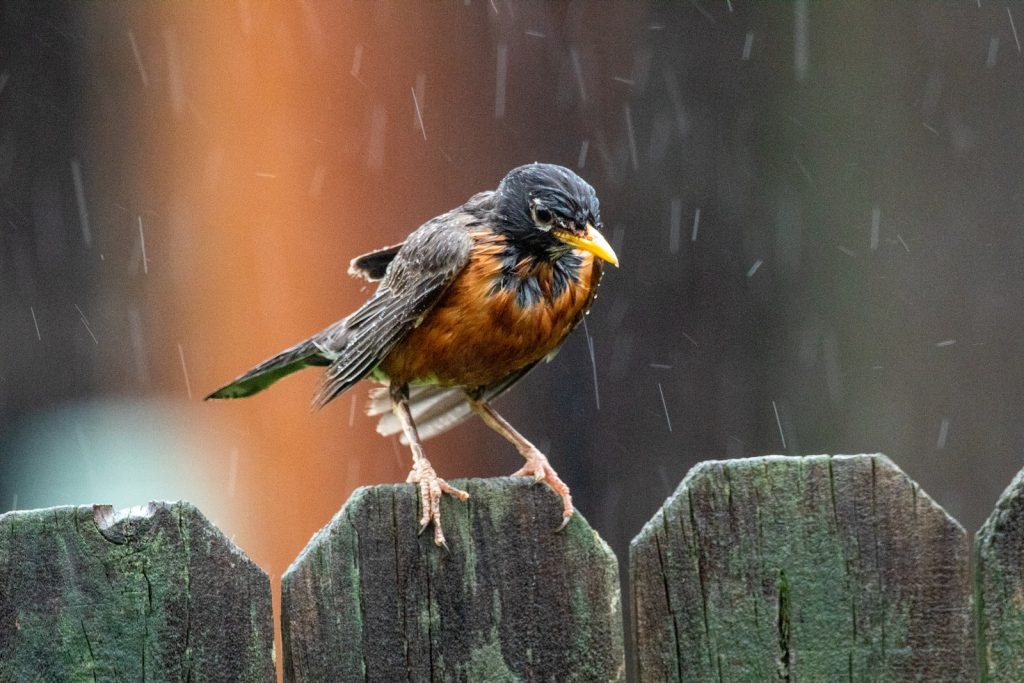
Turdus migratorius AMERICAN ROBIN. Forest, edge,
open woods, pastures, towns, savanna, farms.
T. m. migratorius includes several
subspecies.
The pale race confinus of southern Baja California sometimes is treated
as a separate species, and this may be correct because it differs morphologically
and is isolated from other races by desert and water barriers.
-
T. m. migratorius. From w,n Alaska and n Yukon e across
n Canada (to n limit of trees) to Labrador and Newfoundland, s to s Alaska,
s Calif. (exc. int. and se deserts), s Nevada, c,se Arizona and se Texas,
Gulf
coast and c Florida; s in Mexico to n Sonora, mts. 2400-3050 m to c
Oaxaca and wc Veracruz.
T. m. confinus. Mts. of s Baja Calif. in the Cape
San Lucas area.
Turdus rufitorques RUFOUS-COLLARED ROBIN. Pine-oak
woods, humid forest, edge, cypress woods, pastures. Mts., 1500-3350
m in Chiapas, Guatemala, El Salvador and c Honduras.
Chlamydochaera jefferyi BLACK-BREASTED FRUIT-HUNTER.
Forest. Mts. of N. Borneo (Sabah).
This species was thought to be a cuckoo-shrike until Ames (1975.
Bonn. Zool. Beitr. 26:130) found that it has the "turdine thumb" morphology
of the syringeal musculature. Its turdine affinities were supported
by DNA hybridization (Ahlquist, et al. 1984. J. für Orn. 125:129-140)
and by Olson (1987. J. für Orn. 128:246-248). Plumage
mostly gray with black primaries, a black pectoral band, black outer rectrices
and black subterminal areas on the other rectrices; buffy throat and face;
a black ocular stripe; grayish crown. Feeds on fruit, often associated
with other frugivores, including pigeons, bulbuls and flowerpeckers.
Brachypteryx stellata GOULD'S SHORTWING. Dense undergrowth,
shrubbery, rocks. Himalayas, 2100-4300 m in n India, se Tibet, rarely
in ne Burma, nw Vietnam.
Brachypteryx hyperythra RUSTY-BELLIED SHORTWING.
Forest undergrowth, bamboo, thickets. Himalayas, 1200-2750 m of ne
India from Sikkim e to Arunachal Pradesh and Nagaland.
Brachypteryx major WHITE-BELLIED SHORTWING. Forest
undergrowth. Hills above 900 m of sw peninsular India from s Mysore
to s Kerala.
Brachypteryx leucophrys LESSER SHORTWING. Dense
forest undergrowth, often riparian. Mts., 900-3650 m from the Himalayas
of n India, Burma and s China s to Burma, nw,se peninsular Thailand, Cambodia,
n,s Laos and Vietnam; mts. 700-2100 m in Malaya, Sumatra, Java and the
Lesser Sunda Is. of Bali, Lombok, Sumbawa and Timor.
Brachypteryx montana WHITE-BROWED SHORTWING. Forest
undergrowth, thickets, often riparian. Mts., 1000-3000 m from the
Himalayas of n India e through Burma and sw China to nw Thailand, nw Laos,
Vietnam and Taiwan; mts. of Sumatra, Java, n Borneo, Flores and the Philippine
Is. of Luzon, Mindoro, Palawan, Negros and Mindanao.
Heinrichia calligyna GREAT SHORTWING. Forest undergrowth.
Mts. 1500-3500 m of n,sc,se Sulawesi.
Alethe: Alethes occur in Africa. Medium sized for
thrushes (20 cm). They are 'skulkers' that live on the forest floor
and often feed on insects disturbed by driver ant columns; also eat fruits.
The sexes are alike with upperparts shades of brown or russet, whitish
below, some with white in the rectrices and white or gray eyebrow lines.
Nest of choloensis a cup of green moss in a tree fork; 3 greenish eggs
with chestnut markings.
The Alethes may be muscicapines.
Alethe poliocephala BROWN-CHESTED ALETHE. Forest.
Up to 2450 m in Sierra Leone, Liberia, Ivory Coast, Ghana, s Nigeria, s
Cameroon, Fernando Po I., Gabon, ne,e Zaire, Uganda, s Sudan and w,c Kenyan
highlands, s to nw Angola, se,ce Zaire, sw Tanzania, Burundi and Rwanda.
Alethe poliophrys RED-THROATED ALETHE. Forest.
Mts., 1200-2800 m in ce Zaire, Rwanda, Burundi and sw Uganda. Usually
occurs above poliocephala.
Alethe fuelleborni WHITE-CHESTED ALETHE. Forest.
Mts., 1800-2150 m in ne,s Tanzania, n Malawi, Zambia, and sc Mozambique.
Alethe choloensis CHOLO ALETHE. Forest. Mts.,
ca. 1375 m in s Malawi and nw Mozambique.
Alethe diademata WHITE-TAILED ALETHE. Forest.
The race castanea has been treated as a separate
species (e.g., Sibley and Monroe 1990:522), but the East African
List Committee and Dowsett and Dowsett-Lemaire (1993, p. 354) consider
it to be conspecific with
A. diademata.
A. d. diademata. Forest. Senegambia, Guinea-Bissau,
Guinea, Sierra Leone, Liberia, Ivory Coast, Ghana and Togo.
A. d. castanea. FIRE-CRESTED ALETHE. Forest.
Nigeria, s Cameroon, Fernando Po I.,Equatorial Guinea, Gabon, Congo, Angola,
sw C. African Rep., n,ne Zaire to sw Sudan and Uganda, and s to sw,sc,ce
Zaire and nw Tanzania.
Subfamily MUSCICAPINAE
Tribe MUSCICAPINI
-
Empidornis semipartitus SILVERBIRD. Acacia savanna.
S Sudan, w Ethiopia, e Uganda, w,wc Kenya and nw,nc Tanzania. Often
merged into Bradornis.
Bradornis pallidus PALE FLYCATCHER. Open woods, esp.
brachystegia. From Senegambia e through s Mali, s Niger, Nigeria,
Cameroon, C. African Rep. and s Sudan to w,c Ethiopia, ne,w,c,s, Kenya
and s Somalia, and s (exc. forests) to n Namibia, n Botswana, Zimbabwe
and e S. Africa in e Transvaal and e Natal. The name bafirawari applied
to birds from ne Kenya is sometimes considered a separate species, but
may represent variants of pallidus. B. pallidus has been recorded
in all subSaharan African countries except Liberia, Mauritania, Djibouti,
Equatorial Guinea and the Gulf of Guinea Is.
Bradornis infuscatus CHAT FLYCATCHER. Dry scrub.
Sw Angola, Namibia, Botswana and w,c S. Africa in n,w,c Cape Province,
w Transvaal and w Orange Free State.
Bradornis mariquensis MARIQUA FLYCATCHER. Acacia
savanna. S Angola, sw Zambia, Namibia, Botswana, sw,c Zimbabwe and
n S. Africa in n Cape Province and Transvaal.
Bradornis microrhynchus LARGE FLYCATCHER. Acacia
savanna, woodland. From se Sudan, Ethiopia and Somalia s through
e Uganda and Kenya to s Tanzania.
B. m. pumilus LITTLE GREY FLYCATCHER. Has been treated
as a separate species, but the East African List Committee and Dowsett
and Dowsett-Lemaire (1993), consider pumilus conspecific with microrhynchus.
Dioptrornis chocolatinus ABYSSINIAN SLATY-FLYCATCHER.
Open forest, edge.
The East African List Committee treat fischeri as a race of chocolatinus.
They also retain this species in Melaenornis. Dowsett and Dowsett-Lemaire
(1993) agree. There is no entirely objective evidence to support
or deny either arrangement.
D. c. chocolatinus. Mts. of w,c Ethiopia, Eritrea.
D. c. fischeri WHITE-EYED SLATY-FLYCATCHER.
Open forest, edge. Mts. of ne,ce,se Zaire, extreme se Sudan, Uganda,
w,c Kenya, Rwanda, Burundi, Tanzania, Malawi, ne Zambia.
Dioptrornis brunneus ANGOLA SLATY-FLYCATCHER. Open
forest, edge. Mts. of w Angola, incl. the Cuanza Valley. Dowsett
and Dowsett-Lemaire (1993) include brunneus in chocolatinus, but they are
widely allopatric and it is equally reasonable to consider them to be separate
species.
Melaenornis edolioides NORTHERN BLACK-FLYCATCHER.
Savanna woodland, farms. Sw Mali, s Mauritania, Senegambia, Guinea-Bissau,
Guinea, Burkina Faso, Sierra Leone, Ivory Coast, Ghana, Togo, Benin, Niger,
Nigeria, Cameroon, Congo, C. Afr. Rep., s Chad, s Sudan, Ethiopia, Eritrea,
s to ne Zaire, Uganda, w,c Kenya and nw Tanzania.
Melaenornis pammelaina SOUTHERN BLACK-FLYCATCHER.
Savanna woodland, farms. Wc,c,ec Zaire, Rwanda, Burundi, s Uganda,
Kenya, Tanzania, Malawi, Zambia, s Angola, n Namibia, n,e Botswana, Zimbabwe,
Mozambique and e S. Africa in Transvaal, Natal and e Cape Province.
Melaenornis ardesiacus YELLOW-EYED BLACK-FLYCATCHER.
Forest edge, dense undergrowth. Mts. in ce Zaire, Rwanda, Burundi
and sw Uganda.
Melaenornis annamarulae WEST AFRICAN BLACK-FLYCATCHER.
Humid forest. Foothills in e Sierra Leone, Liberia and wc,sw Ivory
Coast.
Fraseria ocreata AFRICAN FOREST-FLYCATCHER. Humid
forest. Sierra Leone, Liberia, Ivory Coast, Ghana, Nigeria, s Cameroon,
Bioko I., s C. African Rep., n,e Zaire and w Uganda; s to Equatorial Guinea,
Gabon, Congo, sw,sc,ce Zaire and Angola.
Fraseria cinerascens WHITE-BROWED FOREST-FLYCATCHER.
Humid forest. Senegambia, Guinea-Bissau, Guinea, Liberia, Sierra
Leone, Ivory Coast, Ghana, Nigeria, s Cameroon, Gabon, Congo, sw,sc,c Zaire
and Cabinda.
Sigelus silens FISCAL FLYCATCHER. 17-20 cm.
Dry woods, open scrub, gardens. Se Botswana, extreme s Mozambique
and S. Africa.
Rhinomyias addita STREAKY-BREASTED JUNGLE-FLYCATCHER.
Forest. Buru I. in the s Moluccas.
Rhinomyias oscillans RUSSET-BACKED JUNGLE-FLYCATCHER.
Forest. Flores I. in the Lesser Sundas.
Rhinomyias brunneata BROWN-CHESTED JUNGLE-FLYCATCHER.
Forest undergrowth, bamboo thickets. Up to 1100 m in se China from
s Kiangsi and s Honan s to e Kwangsi, Kwantung and Fukien. Winter
range unknown but migrant through the Nicobar Is., possibly resident, Thailand
and Malaya.
Rhinomyias olivacea FULVOUS-CHESTED JUNGLE-FLYCATCHER.
Forest, bamboo thickets. Up to 1100 m in s China, s Burma, peninsular
Thailand, Sumatra incl. Belitung, Java, Bali and n Borneo incl. N. Natuna
and smaller islets.
Rhinomyias umbratilis GREY-CHESTED JUNGLE-FLYCATCHER.
Forest undergrowth. Up to 1100 m in s peninsular Thailand, Malaya,
Sumatra incl. adj. islands, Java and n Borneo incl. N. Natuna Is.
Rhinomyias ruficauda RUFOUS-TAILED JUNGLE-FLYCATCHER.
Forest undergrowth. Borneo (Sarawak and Sabah = n Borneo), and the
c,s Philippine islands of Samar, Leyte, Bohol, Dinagat, Mindanao, Basilan
and the Sulu Archipelago.
Rhinomyias colonus HENNA-TAILED JUNGLE-FLYCATCHER.
Forest undergrowth. Lowlands of e Sulawesi, incl. Peleng and Sula
islands.
Rhinomyias gularis EYEBROWED JUNGLE-FLYCATCHER.
Forest undergrowth. N Borneo (= Sabah) in the vicinity of Mt. Kinabalu.
Sometimes lumped with insignis and albigularis.
Rhinomyias insignis WHITE-BROWED JUNGLE-FLYCATCHER.
Forest undergrowth. Mts. above 1000 m of n Luzon Island in the n
Philippines.
Rhinomyias albigularis WHITE-THROATED JUNGLE-FLYCATCHER.
Forest undergrowth. Sc Philippine islands of Guimaras and Negros.
Rhinomyias goodfellowi SLATY-BACKED JUNGLE-FLYCATCHER.
Forest undergrowth. Mts. above 1000 m on Mindanao in the s Philippines.
Muscicapa striata SPOTTED FLYCATCHER. Open woods,
edge, gardens. From the British Isles and n Scandinavia se across
nw,c Russia to sw Siberia, n Mongolia and w China, s to n Africa from Morocco
e to Tunisia, n Mediterranean region incl. Balearic Is., Sardinia, Corsica,
Crete and Cyprus; Turkey, Near East, nw Arabia, Iran, nw Afghanistan and
s Russia, but absent from the area between the Caspian and Aral seas and
most of Kazakhstan.
Muscicapa gambagae GAMBAGA FLYCATCHER. Acacia steppe.
Locally in s Mali, Liberia, n Ivory Coast, n Ghana, Togo, e Nigeria, Cameroon,
s Chad and s Sudan to w Ethiopia, Djibouti, nw Somalia and sw Arabia, s
to ne Zaire, n Uganda and n,ec Kenya.
Muscicapa griseisticta GREY-STREAKED FLYCATCHER.
Woods. Se Siberia, ne China and Kuril Is.
Muscicapa sibirica DARK-SIDED FLYCATCHER. Open forest.
M. s. cacabata. Mts., 1500-4000 m in the Himalayas in e
Afghanistan, n Pakistan, n India from Kashmir e to Arunachal Pradesh, s
Tibet and c China from Tsinghai, se Kansu and s Shensi s to Yunnan.
This is a distinct montane form, possibly a separate species.
M. s. sibirica. Se Siberia, ne China, Korea, Kuril and
Shantar islands and Japan on Hokkaido and Honshu.
Muscicapa dauurica ASIAN BROWN FLYCATCHER. Forest,
woods, bamboo, often near water. Locally in Himalayan foothills,
900-1900 m in n India, s Siberia, n Mongolia, ne China, Korea, Kuril Is.,
and Japan.
Muscicapa williamsoni BROWN-STREAKED FLYCATCHER.
Forest, woods, near water. Lowlands of se Asia in s Burma, c,sw,
peninsular Thailand, s Vietnam, Malaya, Sumatra and Borneo. Has been
treated as a race of M. dauurica, but differs in plumage and they are allopatric.
Muscicapa randi ASHY-BREASTED FLYCATCHER. Forest,
woods. Luzon and Negros islands in the n,c Philippines. Often
included in dauurica.
Muscicapa segregata SUMBA BROWN FLYCATCHER. Forest,
woods. Sumba I. in the wc Lesser Sundas. Often included in
dauurica.
Muscicapa ruficauda RUSTY-TAILED FLYCATCHER. Forest.
Himalayas, 2100-3600 m in e Uzbekistan, Tadzhikistan, e Afghanistan, n
Pakistan and n India from Kashmir e to Nepal.
Muscicapa muttui BROWN-BREASTED FLYCATCHER. Humid
forest, scrub. Himalayan foothills above 1200 m in ne India, se China,
ne,c,e Burma and nw Thailand.
Muscicapa ferruginea FERRUGINOUS FLYCATCHER. Humid
forest. Himalayas, 600-3050 m in ne,e India, c China and Taiwan.
Muscicapa ussheri USSHER'S FLYCATCHER. Humid forest
clearings. Sierra Leone, Liberia, se Guinea, Ivory Coast, Ghana and
Nigeria.
Muscicapa infuscata SOOTY FLYCATCHER. Humid forest
clearings. S Nigeria, s Cameroon, sw C. African Rep., Equatorial
Guinea, Gabon, Congo, n Zaire, extreme s Sudan, Uganda, nw Tanzania, Zambia,
n Angola and sw,cs,ce,ne Zaire.
Muscicapa boehmi BOEHM'S FLYCATCHER. Brachystegia
woods. From wc,c Angola and cs,se Zaire e through Zambia to sw Tanzania
and Malawi.
Muscicapa aquatica SWAMP FLYCATCHER. Vegetation
bordering swamps and pools. Senegambia, Ivory Coast and Ghana e through
sw Mali, Burkina Faso, Togo, Benin, s Niger, Nigeria, Cameroon, s Chad
and C. African Rep. to s Sudan, s through ne,ce,se Zaire, Uganda, w Kenya,
Rwanda, Burundi and w Tanzania to Zambia.
Muscicapa olivascens OLIVACEOUS FLYCATCHER. Humid
forest. Locally in Sierra Leone, Liberia, Ivory Coast, s Ghana and
s Nigeria e to s Cameroon, Equatorial Guinea, Gabon, Congo, c,ce Zaire,
and in C. African Rep. and n,ne Zaire.
Muscicapa lendu CHAPIN'S FLYCATCHER. Humid forest.
Mts. in ne Zaire, Uganda and the Kakamega Forest in w Kenya. Sometimes
considered a hybrid M. olivascens x M. aquatica but is a valid species.
Muscicapa itombwensis ITOMBWE FLYCATCHER. Humid forest.
Extreme ce Zaire, nw of Lake Tanganyika.
-
Regarded as conspecific with M. lendu by the East African List Committee
(D. A. Turner, pers. comm.). Dowsett and Dowsett-Lemaire (1993, p.
363) note that it is "surprising" that Sibley and Monroe (1990) "recognise
M. itombwensis as a good species, in spite of the fact that the
describer ... had become convinced it was not separable ... probably related
to M. lendu, though with M. olivascens to be considered."
This statement is itself confusing! Which is it? This is
an example of the problems that result from attempts to assign closely-related,
allopatric populations to "species" or "subspecies". It is left here
as a "species" to call attention to this dilemma.
Muscicapa adusta AFRICAN DUSKY FLYCATCHER. Forest,
edge, woods. Cameroon, Fernando Po I., C. Afr., Rep., and from c
Angola, cs,se,ce,ne Zaire, extreme se Sudan, Ethiopia, Eritrea, Uganda,
Rwanda, Burundi, Kenya, Tanzania, Zambia, Malawi, Mozambique, e Zimbabwe
and e,s S. Africa in e Transvaal, Swaziland, w Orange Free State, Natal
and s Cape Province.
Muscicapa epulata LITTLE GREY FLYCATCHER. Humid
forest, edge. Locally in Guinea, Sierra Leone, Liberia, Ivory Coast,
Ghana, Cameroon, Equatorial Guinea, Gabon, sw Congo, sw C. African Rep.
and sw,cn,ne Zaire.
Muscicapa sethsmithi YELLOW-FOOTED FLYCATCHER. Humid
forest. Locally in s Nigeria, s Cameroon, Bioko I., sw C. African
Rep., Equatorial Guinea, Congo, Gabon, cn,ne,c,ce Zaire and w Uganda.
Muscicapa comitata DUSKY-BLUE FLYCATCHER. Dense
forest edge, second growth, farms. Sierra Leone, Liberia, se Guinea,
Ivory Coast, Ghana, Nigeria, s Cameroon, Equatorial Guinea, Gabon, Congo,
sw C. African Rep., n,ne Zaire, Uganda, s to nw Angola, sw,sc,ce Zaire.
Muscicapa tessmanni TESSMANN'S FLYCATCHER. Secondary
forest. Locally in Sierra Leone, Liberia, Ivory Coast, Ghana, Nigeria,
s Cameroon, Equatorial Guinea and sw,ne Zaire.
Muscicapa cassini CASSIN'S FLYCATCHER. Riparian
woods. In Sierra Leone, Liberia, Ivory Coast, Ghana, Togo, Nigeria,
s Cameroon, Gabon, Congo, Angola, C. Afr. Rep., n,ne Zaire and w Uganda,
s to cs,se,ce Zaire, extreme n Zambia.
Muscicapa caerulescens ASHY FLYCATCHER. Humid forest,
edge, second growth, woods, thorn scrub. Sierra Leone, se Guinea,
Burkina Faso, Liberia, Ivory Coast, Ghana, Togo, Benin, Nigeria, s Cameroon,
Gabon, C. Afr. Rep., n,ne Zaire and extreme s Sudan, s Somalia, Uganda,Rwanda,
Burundi, c,s Kenya , Tanzania, Zambia, Malawi, Mozambique, n Namibia, n
Botswana, Zimbabwe and e S. Africa in e Transvaal, Natal and e Cape Province.
Myioparus griseigularis GREY-THROATED TIT-FLYCATCHER.
Humid forest. Locally in Sierra Leone, Liberia, Ivory Coast, Ghana,
s Nigeria, s Cameroon, sw C. African Rep., Equatorial Guinea, Gabon, nw
Angola, Zaire (exc. se), w Uganda and extreme nw Tanzania. Has been
placed in Parisoma.
Myioparus plumbeus GREY TIT-FLYCATCHER. Woods, second
growth. Senegambia, s Mali, Burkina Faso, Sierra Leone, Liberia,
Ivory Coast, Ghana, Togo, Benin, Nigeria, s Niger, Cameroon, Gabon, Congo,
Zaire, C. African Rep., s Chad, s Sudan, s Ethiopia, Rwanda, Uganda, Kenya,
Tanzania, Zambia, Malawi, Mozambique, s Angola, ne Namibia, n Botswana,
Zimbabwe and e S. Africa in n,e Transvaal, e Swaziland and e Natal.
Humblotia flavirostris HUMBLOT'S FLYCATCHER. Forest.
Grand Comoro I., n of Madagascar.
Ficedula hypoleuca EUROPEAN PIED FLYCATCHER. Open
forest, woods, gardens, orchards, towns. From the British Isles and
Scandinavia e across nw,c Russia to sw Siberia and s in Europe to w,n France,
n Italy, Yugoslavia and Bulgaria; locally in the Iberian Peninsula and
n Africa from Morocco to Tunisia.
Ficedula albicollis COLLARED FLYCATCHER. Open forest,
woods, gardens, orchards, towns. Locally from e France, Germany,
islands in the Baltic Sea, and w Russia e to Moscow, s to Italy, Sicily,
Yugoslavia, Romania and Ukraine.
Ficedula semitorquata SEMICOLLARED FLYCATCHER. Open
forest, mostly montane. Locally from Greece, Turkey and Near East
e to the Caucasus, Transcaucasus, sw Transcaspia and w,n Iran. Sometimes
included in F. hypoleuca or F. albicollis, but behaviorally and vocally
distinct from both.
Ficedula zanthopygia YELLOW-RUMPED FLYCATCHER. Forest,
woods, usually near water. Mts. in se Siberia, e Mongolia, nc,e China
and Korea.
Ficedula narcissina NARCISSUS FLYCATCHER. Forest,
woods, usually near water. Se Siberia, n China, Sakhalin, Japan on
Hokkaido and Honshu, and the Ryukyu Is.
Ficedula mugimaki MUGIMAKI FLYCATCHER. Coniferous
forest. Se Siberia and ne China.
Ficedula hodgsonii SLATY-BACKED FLYCATCHER. Humid
forest edge, dense scrub. Mts., 1200-3900 m in the Himalayas of ne
India from e Nepal e to Assam, se Tibet, c,sc China and Burma, exc. c.
Ficedula strophiata RUFOUS-GORGETED FLYCATCHER.
Forest, edge. Mts., 1000-3650 m from the Himalayas of n,e India,
se Tibet and c China, s to w,ne Burma and s Vietnam.
Ficedula parva RED-BREASTED FLYCATCHER. Woodland
undergrowth, open forest.
The two following subspecies may be separate species.
F. p. parva. From Denmark, s Scandinavia, Poland,
Yugoslavia and Romania e to ec Russia in the s Ural Mts., Ukraine, and
s locally to the Balkans, Caucasus, Transcaucasus, n Turkey and n Iran
in the s Caspian region.
F. p. albicilla. C,s Siberia from the Urals e to
Kamchatka and n Mongolia, possibly e Tibet.
Ficedula subrubra KASHMIR FLYCATCHER. Woodland undergrowth,
open forest. Himalayas, 1800-2700 m in Kashmir, n India. Sometimes
lumped with parva.
Ficedula monileger WHITE-GORGETED FLYCATCHER. Forest
undergrowth, dense second growth, bamboo. Mts., 700-2000 m in the
Himalayas of ne,e India, sw China, s Burma, nw Thailand, Laos and n,c Vietnam.
Ficedula solitaris RUFOUS-BROWED FLYCATCHER. Forest
undergrowth.
F. s. submoniliger. Mts., 750-2400 m in se Burma, w, peninsular
Thailand and s Vietnam in s Annam. May be a separate species from
F. s. solitaris or a subspecies of F. monileger.
F. s. solitaris. Malay Peninsula (exc. n,c peninsular
Thailand) and Sumatra.
Ficedula hyperythra SNOWY-BROWED FLYCATCHER. Forest
undergrowth. Mts., 500-3000 m from the Himalayas of n,e India, se
China and Taiwan s through Burma (exc. c,s), nw Thailand, n,s Laos and
Vietnam to Malaya, Sumatra, Java, Bali, Lombok, Sumbawa, Flores, Borneo,
Sulawesi, the Moluccan islands of Bacan, Buru and Seram, and the Philippine
islands of Calayan, Luzon, Mindoro, Palawan, Negros and Mindanao.
Related to dumetoria.
Ficedula dumetoria RUFOUS-CHESTED FLYCATCHER. Humid
forest, bamboo. Lowlands to 1200 m in peninsular Thailand, Malaya,
Sumatra, Java, Lombok, Sumbawa, Flores, Bornea and the Tanimbar Is.
Ficedula rufigula RUFOUS-THROATED FLYCATCHER. Forest.
Lowlands to 600 m of Sulawesi.
Ficedula buruensis CINNAMON-CHESTED FLYCATCHER. Forest.
Hills, 600-1000 m in the s Moluccas on Buru and Seram and on Kai Besar
in the Kai Islands.
Ficedula basilanica LITTLE SLATY FLYCATCHER. Forest
undergrowth, second growth. Lowlands to 1000 m on Samar, Leyte, Dinagat,
Mindanao and Basilan in the Philippines.
Ficedula henrici DAMAR FLYCATCHER. Forest.
Known only from a few specimens from Damar I. in the e Lesser Sunda Is.
Ficedula harterti SUMBA FLYCATCHER. Forest.
Sumba I. in the wc Lesser Sundas.
Ficedula platenae PALAWAN FLYCATCHER. Forest undergrowth,
second growth. Up to 1000 m on Palawan I. in the sw Philippines.
Ficedula crypta CRYPTIC FLYCATCHER. Forest undergrowth,
second growth. Up to 1500 m in c Luzon and Mindanao in the Philippines.
Ficedula bonthaina LOMPOBATTANG FLYCATCHER. Humid
forest undergrowth. Lompobattang Mt. in sw Sulawesi.
Ficedula westermanni LITTLE PIED FLYCATCHER. Forest,
edge, bamboo. Mts., 1000-2700 m from e India, Burma (exc. c), and
sw China, s through nw,se, and peninsular Thailand, Laos and n,c Vietnam
to Malaya, Sumatra, Java, Bali, Lombok, Sumbawa, Flores, Alor, Timor and
Wetar; and Philippine islands of Luzon, Palawan, Panay, Negros, Camiguin
Sur and Mindanao. (= Muscicapula melanoleuca.)
Ficedula superciliaris ULTRAMARINE FLYCATCHER. Forest.
Mts., 1500-3200 m from n Pakistan and n,e India e to sw China and c,e Burma.
Ficedula tricolor SLATY-BLUE FLYCATCHER. Forest undergrowth,
thickets, scrub, grassy areas. Mts., 1500-4000 m from the Himalayas
of n India and se Tibet to c China, w,ne,e Burma, nw Thailand, n Laos and
n Vietnam.
Ficedula sapphira SAPPHIRE FLYCATCHER. Forest.
Foothills and mts., 2000-2600 m from e India and se Tibet e to sc China
and ne,e Burma, nw Thailand and n Laos.
Ficedula nigrorufa BLACK-AND-RUFOUS FLYCATCHER.
Forest undergrowth. Mts. above 700 m of sw India from w Maharashtra
s to Kerala.
Ficedula timorensis BLACK-BANDED FLYCATCHER. Brushy
areas (?). Up to 1200 m on Timor I.
Cyanoptila cyanomelana BLUE-AND-WHITE FLYCATCHER.
18 cm. Forest, woods, riparian cliffs. Se Siberia, ne China,
Korea and Japan on Hokkaido, Honshu and Kyushu. Male blue above and
below, except white belly; female pale blue above, brownish to white below.
Eumyias thalassina VERDITER FLYCATCHER. Open forest,
edge, riparian bushes. Up to 3000 m from Himalayan foothills in n,e
India and c,se China s through se Asia to Sumatra and Borneo.
Eumyias sordida DULL-BLUE FLYCATCHER. Forest.
Hills, 900-2100 m of Sri Lanka.
Eumyias panayensis ISLAND FLYCATCHER. Forest, woods.
Mts., 600-2150 m in Sulawesi and the Philippine islands of Luzon, Mindoro,
Panay, Negros and Mindanao; s Moluccas on Obi and Seram is.
Eumyias albicaudata NILGIRI FLYCATCHER. Open forest,
edge, riparian second growth, woods, gardens, towns. Hills, 600-1200
m in sw India from Mysore s to Kerala.
Eumyias indigo INDIGO FLYCATCHER. Forest.
Mts., 900-2400 m on Sumatra, Java and Borneo.
Niltava: Niltavas. 14-20 cm.
Males blue above; grandis, macgrigoriae and davidi
also blue below; sundara, sumatrana and vivida orange-rufous below; females
brownish.
All species and both sexes have a pale blue patch
on the side of the neck. Undergrowth and lower portions of forests;
feed by flycatching and on the ground.
Nest a moss cup placed in a hole or crevice;
eggs 3-5, buffy, whitish, pinkish, or yellowish with reddish or buffy speckles.
Niltava grandis LARGE NILTAVA. Forest undergrowth.
Foothills and mts., 900-2700 m from ne,e India and sw China s through Burma
(exc. c,s) and Indochina to Malaya and Sumatra.
Niltava macgrigoriae SMALL NILTAVA. Forest undergrowth,
edge, bushes, usually near water. Foothills and mts., 900-2500 m
from the Himalayas of n,e India and sw China, s to w,ne,e Burma, nw Thailand,
n,s Laos and n Vietnam.
Niltava davidi FUJIAN NILTAVA. Forest undergrowth.
Up to 1250 m in c,s China, se Thailand, Laos and n,c Vietnam.
Niltava sundara RUFOUS-BELLIED NILTAVA. Forest undergrowth,
edge. Himalayas, 1500-2700 m in n Pakistan, n,e India, se Tibet,
c,s China and Burma (exc. c,s).
Niltava sumatrana RUFOUS-VENTED NILTAVA. Forest undergrowth.
Mts., 1000-3400 m of Malaya and Sumatra.
Niltava vivida VIVID NILTAVA. Forest, open woods.
Himlayas, 2100-2700 m in ne India, se Tibet, sc China, Burma (exc. ne,s),
nw,se Thailand, n Laos, n Vietnam and Taiwan.
Cyornis sanfordi MATINAN FLYCATCHER. Forest.
Mts. above 1400 m of n Sulawesi.
Cyornis hoevelli BLUE-FRONTED FLYCATCHER. Forest.
Mts., 1400-2000 m of c,se Sulawesi.
Cyornis hyacinthinus TIMOR BLUE-FLYCATCHER. Forest.
Up to 2000 m on Timor and Wetar islands in the c Lesser Sunda Is.
Cyornis concretus WHITE-TAILED FLYCATCHER. Forest
undergrowth. Mts., 300-1200 m in w,ne Burma, n Laos, n Vietnam, Malay
Peninsula, Sumatra and Borneo.
Cyornis ruckii RUECK'S BLUE-FLYCATCHER. Forest.
Lowlands to 200 m of Sumatra.
Cyornis herioti BLUE-BREASTED FLYCATCHER. Forest.
Mts. above 750 m on Luzon and Catanduanes islands in the n Philippines.
Cyornis hainanus HAINAN BLUE-FLYCATCHER. Forest
undergrowth, bamboo, mangroves. Lowlands to 1000 m in se China, Hainan
I., s,e Burma incl. Tenasserim, and Indochina, except extreme se.
Cyornis pallipes WHITE-BELLIED BLUE-FLYCATCHER.
Forest undergrowth, edge, second growth. Foothills to 1700 m of sw
India from w Maharashtra s to Kerala.
Cyornis poliogenys PALE-CHINNED FLYCATCHER. Forest,
edge, second growth, scrub. Up to 1550 m in ne,e India; e Ghats of
n Orissa and ne Andhra Pradesh, sw China in nw Yunnan and w,ne,s Burma.
Cyornis unicolor PALE BLUE-FLYCATCHER. Forest, second
growth, bamboo. Lowlands and foothills to 2000 m from n,e India and
sw China s through Burma (exc. s), nw,ne, peninsular Thailand, Laos and
Malaya; Sumatra, Java and Borneo.
Cyornis rubeculoides BLUE-THROATED FLYCATCHER. Forest
undergrowth, second growth, gardens. Foothills to 2100 m in n,ne
India, c,s China, Burma, nw,sw,ne Thailand, s Laos and c Vietnam.
The form glaucicomans differs vocally from all
other races of rubeculoides and other species of Cyornis; B. King (pers.
comm.) considers glaucicomans to be a separate species. |