| Hypogramma hypogrammicum PURPLE-NAPED SUNBIRD. Forest,
second growth. Lowlands to 1000 m from n,c,s Burma and sw China s
through nw,pen. Thailand, Indochina, (exc. Cambodia), through Malaya to
Sumatra, Borneo and N. Natuna Is.
Nectarinia seimundi LITTLE GREEN SUNBIRD. Second
growth, clearings, edge. Sierra Leone, Liberia, Ivory Coast, Ghana,
Togo, Nigeria, Cameroon, Bioko I., Gabon, Congo, sw C. African Rep., n,e
Zaire, extreme s Sudan, e Uganda, Rwanda, s to nw Angola and sw,cs,ce Zaire.
Nectarinia batesi BATES'S SUNBIRD. Forest edge,
clearings, second growth. Ivory Coast, Ghana, s. Nigeria, s Cameroon,
Bioko I., Gabon, c,ce,se Zaire, e Angola and nw Zambia.
Nectarinia olivacea OLIVE SUNBIRD. Forest edge,
second growth. Sw Mali, Senegambia, Guinea-Bissau, se Guinea, Sierra
Leone, Liberia, Ivory Coast, Ghana, Togo, Benin, Nigeria, s Cameroon, Bioko
I., Equatorial Guinea, Gabon, Congo, C. African Rep., n,ne Zaire, extreme
s Sudan and sw,c Ethiopia and s Somalia, Rwanda, Burundi, Uganda, Kenya,
Tanzania s to c Angola, c,n Zambia, e Zimbabwe, Mozambique and se S. Africa.
Nectarinia violacea ORANGE-BREASTED SUNBIRD. Protea
heathland. Mts. of s S. Africa in sw,s Cape province.
Nectarinia veroxii MOUSE-COLORED SUNBIRD. Coastal
and riparian forest. S. Somalia, e Kenya, e Tanzania s along coast
and major rivers, incl. Zanzibar I., Malawi, Zimbabwe and Mozambique to
sc s Africa.
Nectarinia reichenbachii REICHENBACH'S SUNBIRD.
Clearings, palms, shrubs. Liberia, Ivory Coast, Ghana, Nigeria, e
to s Cameroon, nw,cn Zaire, Gabon, Congo, Cabinda s to Congo R. mouth,
sw,sc,ce Zaire and ne Angola.
Nectarinia hartlaubii PRINCIPE SUNBIRD. Forest,
scrub. Principé I.
Nectarinia newtonii NEWTON'S SUNBIRD. Forest, scrub.
São Tomé I.
Nectarinia thomensis SAO TOME SUNBIRD. Forest.
Mts. of São Tomé I.
Nectarinia oritis CAMEROON SUNBIRD. Forest.
Mts., 1200-2100 m of se Nigeria and Cameroon,
incl. Bioko I. (=Fernando Po). This and the following species
are montane representatives of the N. verticalis superspecies and sometimes
are regarded as part of it; however, alinae and amethystina are sympatric
in Rwanda.
Nectarinia alinae BLUE-HEADED SUNBIRD. Forest.
Mts., 1300-3300 m of ne,ce Zaire, w Uganda, Rwanda and Burundi.
Nectarinia verticalis GREEN-HEADED SUNBIRD. Forest,
woodland, edge. Lowlands to 2750 m in Senegambia, s Mali, Burkina
Faso, Guinea, Sierra Leone, Liberia, Ivory Coast, Ghana, Togo, Benin, Nigeria,
Cameroon, Equatorial Guinea, Gabon, Congo, C. African Rep., se Sudan, Uganda,
Rwanda, Burundi, w,c Kenya, w,s Tanzania, s to nw Angola, sw,cs,ce Zaire,
ne,ce Zambia and nw Malawi.
Nectarinia bannermani BANNERMAN'S SUNBIRD. Forest,
woodland. C,n Angola, se Zaire and extreme nw Zambia. Sometimes
regarded as conspecific N. verticalis but may be marginally sympatric
with it in nw Angola.
Nectarinia cyanolaema BLUE-THROATED BROWN SUNBIRD.
Forest, second growth. Sierra Leone, se Guinea, Liberia, Ivory Coast,
Ghana, Togo, Nigeria, Cameroon, Bioko I., Equatorial Guinea, Gabon, Congo,
n,ne Zaire, w,c Uganda, Rwanda and w Kenya and s to nw,ne Angola, sw,cs,ce
Zaire and nw Tanzania.
Nectarinia balfouri SOCOTRA SUNBIRD. Forest, second
growth. Socotra I. May be closely related to N. dussumieri.
Nectarinia dussumieri SEYCHELLES SUNBIRD. Forest,
second growth, farmlands. Seychelles Is.
Nectarinia fuliginosa CARMELITE SUNBIRD. Coastal
woodland. Sierra Leone, Liberia, Ivory Coast, Ghana, Togo, Benin,
Nigeria, Cameroon, Equatorial Guinea, sw Gabon, Congo, sw Zaire and nw
Angola. This and the following two species are closely related; fuliginosa
and amethystina hybridize occasionally where they overlap.
Nectarinia amethystina AMETHYST SUNBIRD. Open woodland.
Gabon, Congo, Angola, sw,cs,se Zaire, se Sudan, s Ethiopia, s Somalia,
Uganda, Burundi, Kenya, Tanzania, Zambia, Malawi, ne Namibia, n,se Botswana,
Zimbabwe, Mozambique and e,s S. Africa.
Nectarinia rubescens GREEN-THROATED SUNBIRD. Forest,
edge. S Cameroon, Bioko I., C. African Rep., Equatorial Guinea, Gabon,
Congo, n,ne Zaire, extreme se Sudan, Uganda, Rwanda, Burundi and w Kenya
s to nw,cn Angola, nw Zambia, s,se Zaire and nw Tanzania.
Nectarinia senegalensis SCARLET-CHESTED SUNBIRD.
Savanna woodland. Senegambia, s Mauritania, s Mali, Burkina Faso,
Guinea-Bissau, Guinea, Sierra Leone, Ivory Coast, Ghana, Togo, Benin, s
Niger, Nigeria, Cameroon, C. Afr. Rep., s Chad and s Sudan to w,c Ethiopia,
Eritrea, ne Zaire, Rwanda, Burundi, Kenya, (exc. ne), Tanzania, incl. Zanzibar
and Pemba Is., Zambia, Malawi, s Angola, c Namibia, n Botswana, Zimbabwe,
Mozambique and ne S. Africa.
Nectarinia hunteri HUNTER'S SUNBIRD. Arid thorn
savanna. Extreme se tip of Sudan, ne Uganda, e,extreme s Ethiopia,
Somalia, n,e Kenya, and extreme ne Tanzania. Sometimes regarded as
conspecific with, N. senegalensis but marginally sympatric with the latter
in e Kenya, although usually ecologically segregated in the area of overlap.
Nectarinia adelberti BUFF-THROATED SUNBIRD. Forest.
Guinea, Sierra Leone, Liberia, Ivory Coast, Ghana, Togo, Benin and se Nigeria.
Related to N. senegalensis and sometimes treated as part of the same superspecies.
Nectarinia zeylonica PURPLE-RUMPED SUNBIRD. Forest,
farmlands. Lowlands to 1200 m in pen.,e India, Sri Lanka, N
to Bangladesh and w Burma.
Nectarinia minima CRIMSON-BACKED SUNBIRD. Forest,
farmlands. Foothills to 2100 m of w, sw India; possibly Sri Lanka.
Nectarinia sperata PURPLE-THROATED SUNBIRD. Forest,
mangroves, farmlands, second growth. Lowlands to 1000 m in e India,
w,s Burma, Thailand, (exc. nw,sw), Cambodia, s Laos, s Vietnam, Malaya,
Sumatra, Borneo and Java, incl. surrounding is. near these three;
Malay Arch. on Maratua I; Philippine Is. of Luzon, Babuyan Is., Camiguin
Norte s to Palawan and Mindanao, Basilan and Sulu Arch.
Hybridization occurs between the red-backed sperata and the black-backed
henkei groups across central Luzon and between the red-breasted sperata
and yellow-breasted juliae groups in se Mindanao.
Nectarinia aspasia BLACK SUNBIRD. Forest, edge.
Lowlands of Wallacea Is. and Sulawesi, incl. adj. is., s Moluccas, Aru,
Kei and w Papuan Is. of Waigeo, Salawati, Misool and New Guinea, incl.
adj. is., D'Entrecasteaux Arch., Louisade Arch. and Bismarck Arch.
Nectarinia calcostetha COPPER-THROATED SUNBIRD.
Mangroves, scrub, farmlands. Mainly coastal to 1000 m in s Burma,
w, pen.,se Thailand, Cambodia, s Vietnam, Malaya, Sumatra, Borneo, Java,
and adj. small is., and Philippine Is. of Palawan and Balabac.
Nectarinia jugularis OLIVE-BACKED SUNBIRD. Forest
edge, second growth, towns, mangroves, farmlands. Lowlands to 1700
m from se China s through se Asia, (exc. ne Burma, n Vietnam); Andaman
and Nicobar is. to Sumatra, incl. surrounding is., Borneo, Java, Lesser
Sunda Is., Sulawesi, Philippines and Moluccas, New Guinea,
w Papuan is., Bismarck Arch., Solomon Is., and ne Australia.
Nectarinia buettikoferi APRICOT-BREASTED SUNBIRD.
Forest edge, second growth, farmlands. Sw Lesser Sunda Is. of Sumba.
Nectarinia solaris FLAME-BREASTED SUNBIRD. Forest
edge, second growth, farmlands. Lowlands to 1000 m of Lesser Sunda
Is. of Sumbawa, Flores, Lomblen, Alor, Semau, Roti, Timor, Wetar.
Nectarinia sovimanga SOUIMANGA SUNBIRD. Forest,
second growth, mangroves. Lowlands to 2000 m of Madagascar and Aldabra
and Glorieuses is.
Nectarinia humbloti HUMBLOT'S SUNBIRD. Forest, second
growth. W Comoro Is. of Grand Comoro and Mohéli.
Nectarinia comorensis ANJOUAN SUNBIRD. Forest, second
growth. C Comoro Is. of Anjouan. May be a race of N. sovimanga.
Nectarinia coquerellii MAYOTTE SUNBIRD. Forest,
second growth. Se Comoro Is. of Mayotte.
Nectarinia venusta VARIABLE SUNBIRD. Open woodland, towns,
thorn savanna, forest. Senegambia, sw Mali, Burkina Faso, Sierra
Leone, se Guinea, Liberia, Ivory Coast, Ghana, Togo, Benin, Nigeria, Cameroon,
C. African Rep., s Sudan and w,c,s,e Ethiopia, Eritrea, Somalia s through
w,c,e Uganda, Rwanda, Burundi, w,s,se,e Kenya, Tanzania, Malawi to c Mozambique,
n,e Zimbabwe and ne S. Africa and w through Zambia and s,ce,ne Zaire to
Angola, s Gabon and Congo.
Nectarinia ursulae URSULA'S SUNBIRD. Forest.
Mts., 1000-2000 m of Cameroon and Bioko I. in the Gulf of Guinea Islands.
Closely related to N. venusta.
Nectarinia talatala WHITE-BREASTED SUNBIRD. Dry
woodland, thorn savanna, farmlands. Cw,s,ce Angola e across Zambia,
Malawi and extreme se Zaire to extreme s Tanzania and s to n Namibia, n,e
Botswana, Zimbabwe, Mozambique and ne,e S. Africa.
Nectarinia oustaleti OUSTALET'S SUNBIRD. Brachystegia
woodland. Locally in c Angola, extreme ne Zambia, Malawi and extreme
sw Tanzania. N. oustaleti may have originated from hybridization
between N. talatala and N. bouvieri.
Nectarinia bouvieri ORANGE-TUFTED SUNBIRD. Savanna
near forest, woodland. Extreme se Nigeria, s Cameroon, Equatorial
Guinea, Gabon, Congo, c,s C. African Rep., ne Zaire and w,s Uganda and
w Kenya s (exc. forested areas) to n Angola, s Zaire (exc. extreme se)
and extreme nw Zambia.
Nectarinia osea PALESTINE SUNBIRD. Thorn savanna.
Locally in Cameroon, n C. African Rep., extreme ne Zaire; s Syria, Israel,
w,se Arabia e to s Oman. Populations in Near East winter to sw Arabia.
Nectarinia asiatica PURPLE SUNBIRD. Woodland, forest,
thorn scrub, farmlands. Lowlands to 1500 m from ne Arabia, Aman and
se Iran e through Afghanistan, Pakistan and India, incl. Himalayan foothills,
Sri Lanka to Burma, sw China, nw,ne,sw Thailand, Cambodia, s,c Laos and
c,s Vietnam.
Nectarinia habessinica SHINING SUNBIRD. Rocky thornbush
country. Ne Sudan, Ethiopia, Eritrea, Djibouti, Somalia, n,c Kenya;
sw Saudi Arabia e to s Oman.
Nectarinia lotenia LONG-BILLED SUNBIRD. Forest,
farmlands. Plains to 1200 m in s pen. India and Sri Lanka.
Nectarinia manoensis MIOMBO DOUBLE-COLLARED SUNBIRD.
Forest edge, scrub, farmlands. Lowlands to 2000 m of c Angola, se
Zaire, Zambia, Malawi and s Tanzania s to e Botswana, Zimbabwe and
s Mozambique. Sometimes considered conspecific with N. chalybea.
Nectarinia chalybea SOUTHERN DOUBLE-COLLARED SUNBIRD.
Forest edge, scrub, farmlands. S. Africa and Namibia.
Nectarinia afra GREATER DOUBLE-COLLARED SUNBIRD.
Forest. S. Africa in Transvaal, Natal and s Cape Province.
The relationships among the members of the N. afra group (afra, ludovicensis,
prigogenei, stuhlmanni) are unclear. D. A. Turner (pers. comm.) reports
that the East African List Committee accept the conclusions of Dr. J. P.
Vander Weghe, who is of the opinion that there is only one species of large
double-collared sunbird in w Uganda, the Ruwenzori Mts. and the Virunga
volcanos of Rwanda and Zaire. On different mountains they differ
in bill size, but are alike vocally and ecologically, and do not differ
from the montane populations of Malawi.
The conclusion is that ludovicensis, prigogenei and stuhlmanni should
be treated as races of N. afra. There are many parallel situations
in which allopatric populations are similar in several respects, but not
in contact and thus unable to be tested for the ability to interbreed.
Different species concepts produce different opinions. Dowsett and
Dowsett-Lemaire (1993) provide an extensive discussion of the "Nectarinia
afra superspecies". They note that they have had "intensive field
experience" with "live birds in the hand and recorded vocalisations".
They include ludovicensis, prigogenei and stuhlmanni as subspecies of N.
afra. This situation is like others involving allopatric populations
-- there are differences and similarities and the taxonomic treatment depends
on the species concept of the taxonomist. Treating these populations
as "species" calls attention to them. The fact is, we don't know
whether they are "species", "incipient species" or "subspecies" -- we do
know that they are closely-related allopatric populations.
Nectarinia ludovicensis MONTANE DOUBLE-COLLARED SUNBIRD.
Forest. Mts. above 1800 m of wc,sw Angola. Sometimes considered
conspecific with N. afra.
Nectarinia prigoginei PRIGOGINE'S DOUBLE-COLLARED SUNBIRD.
Forest. Mts., 1800-3650 m in ne,ce, se Zaire (exc. Ruwenzori Mts.),
w Uganda, w Malawi and ne Zambia. Sometimes considered conspecific
with N. ludovicensis or N. afra, but may have originated from hybridization
between N. mediocris and N. atra.
Nectarinia stuhlmanni STUHLMANN'S DOUBLE-COLLARED SUNBIRD.
Forest. Known only from Ruwenzori Mts., 1900-4100 m, of ce Zaire.
Sometimes considered conspecific with N. afra.
Nectarinia preussi NORTHERN DOUBLE-COLLARED SUNBIRD.
Forest. Locally common in highlands, 1200-2600 m of se Nigeria, se
Cameroon, Bioko I.; s C. Afr. Rep., extreme se Sudan, ne,ce Zaire, w Uganda,
Ruanda, Burundi, c,sw Kenya.
Nectarinia mediocris EASTERN DOUBLE-COLLARED SUNBIRD.
Forest. Mts. of Kenya, e,se Tanzania, se Zaire, Zambia, Malawi
and n Mozambique.
Nectarinia neergaardi NEERGAARD'S SUNBIRD. Thornveld
and sand forest. Se Mozambique and extreme e S. Africa.
Nectarinia chloropygia OLIVE-BELLIED SUNBIRD. Forest.
Senegambia, s Mali, Guinea, Sierra Leone, Liberia, Ivory Coast, Ghana,
Togo, Benin, Nigeria, Cameroon, Bioko I., Equatorial Guinea, Gabon, Congo,
C. African Rep., ne Zaire, s Chad, s Sudan, s Ethiopia, Rwanda, Burundi,
Uganda and w Kenya and s to n Angola, s,se Zaire and nw Tanzania.
An isolated population in sw Ethiopia may be conspecific with N. preussi.
Nectarinia minulla TINY SUNBIRD. Forest edge, second
growth. Sierra Leone, Liberia, Ivory Coast, Ghana, Nigeria, Cameroon,
Bioko I., Gabon, Congo, e Zaire, w Uganda s to s Zaire.
Nectarinia regia REGAL SUNBIRD. Forest. Mts., 1750-2400
m of w Uganda, Rwanda, Burundi, e Zaire, and extreme w Tanzania, e of L.
Tanganyika.
Nectarinia loveridgei LOVERIDGE'S SUNBIRD. Forest,
clearings. Uluguru Mts., 750-2300 m, of ce Tanzania. Sometimes
merged with mediocris.
Nectarinia moreaui MOREAU'S SUNBIRD. Forest.
Mts. above 1200 m of ce Tanzania. Once thought to represent mediocris
x loveridgei hybrids, but at least one nest hase been reported; sometimes
merged with mediocris.
Nectarinia rockefelleri ROCKEFELLER'S SUNBIRD. Bamboo,
heath. Mts., 2050-3300 m, of ce Zaire.
Nectarinia cuprea COPPER SUNBIRD. Savanna woodland.
Senegambia, s Mauritania, sw Mali, Burkina Faso, Guinea-Bissau, se Guinea,
Sierra Leone, Liberia, Ivory Coast, Ghana, Togo, Benin, Nigeria, s Niger,
Cameroon, C. African Rep., Gabon, Congo, s Chad, s Sudan, Ethiopia, Uganda,
ne Zaire, Rwanda, Burundi, w Kenya, w,s Tanzania s to s Angola, extreme
ne Namibia, s Zambia, Malawi, n Zimbabwe and c,n Mozambique.
Nectarinia fusca DUSKY SUNBIRD. Arid, rocky areas.
Cw, sw Angola s through Namibia and sw Botswana to nw,nc S. Africa.
Nectarinia rufipennis RUFOUS-WINGED SUNBIRD. Forest.
ca. 1000 m, ec Tanzania in Udzungwa Mts. A recently (1983) discovered
species without obvious close relatives.
Nectarinia tacazze TACAZZE SUNBIRD. Grassy areas
at forest edge. Mts. above 1800 m of Ethiopia, Eritrea, se Sudan,
ne Uganda, w,c Kenya and ne Tanzania.
Nectarinia purpureiventris PURPLE-BREASTED SUNBIRD.
Forest openings. Mts., 1500-2600 m of ne,ce Zaire, w Uganda, Rwanda
and Burundi.
Nectarinia bocagii BOCAGE'S SUNBIRD. Woodland.
Highlands of c Angola and cs Zaire.
Nectarinia kilimensis BRONZE SUNBIRD. Clearings,
forest edge, bushy grassland. Mts. of Angola; locally in mts., 1200-1800
m of s Ethiopia, ne,ce,se Zaire, Uganda, incl. lowlands, e Zaire, w,c,se
Kenya, Rwanda, Burundi, extreme ne Zambia, Tanzania, Malawi, e Zimbabwe
and sc Mozambique.
Nectarinia reichenowi GOLDEN-WINGED SUNBIRD. Grassland,
bamboo. Mts. above 1500 m of se Uganda, Kenya and ne Tanzania; mts.
above 2100 m in ce Zaire, nw of L. Tanganyika.
Nectarinia famosa MALACHITE SUNBIRD. Open areas
with aloes, proteas, bushes. Locally in mts., above 1500 m, of Ethiopia,
se Sudan, ne,ce,se Zaire, Uganda, Kenya, Rwanda, Burundi, Tanzania, Zambia,
Malawi, e Zimbabwe, n Namibia and sc Mozambique; high mts. of S. Africa.
Nectarinia johnstoni RED-TUFTED SUNBIRD. Alpine
moorlands with Erica and giant lobelias. Mts., 2100-4300 m of ne,ce
Zaire, w Uganda, Rwanda, c Kenya, ne,sw Tanzania, n Zambia and n Malawi.
Nectarinia shelleyi SHELLEY'S SUNBIRD. Brachystegia
woodland. S Tanzania, Malawi, se Zaire, e Zambia, e Zimbabwe and
n Mozambique.
Nectarinia erythrocerca RED-CHESTED SUNBIRD. Riparian
areas in savanna, towns. Ne,ce Zaire, s Sudan, Uganda, w Kenya, Rwanda,
Burundi and nw Tanzania.
Nectarinia congensis CONGO SUNBIRD. Riparian vegetation.
Forested banks of upper Congo R. in nw,ne Zaire and Congo.
Nectarinia mariquensis MARIQUA SUNBIRD. Acacia savanna.
Extreme se Sudan, Ethiopia, Eritrea, nw Somalia, Uganda, Rwanda, Burundi,
Kenya (exc.ne), Tanzania and extreme ne Zambia; c Angola and sw Zambia
s through Namibia (exc. w,s), Botswana and w,s Zimbabwe to sw Mozambique
and ne S. Africa.
Nectarinia bifasciata PURPLE-BANDED SUNBIRD. Acacia
savanna, woodland.
The two subspecies groups may be separate species, perhaps sympatric
in n Tanzania and possibly in se Kenya.
N. b. tsavoensis S Ethiopia, s Somalia and e Kenya
to ne Tanzania, but not in coastal areas.
N. b. bifasciata Gabon, Congo, s,e Zaire, Rwanda,
Uganda, w Kenya and Tanzania, incl. Zanzibar and Mafia is., s to Angola,
n Namibia, n Botswana, Zambia, Malawi, n,e Zimbabwe, Mozambique and ne
S. Africa in extreme e Transvaal, e Swaziland and Natal.
Nectarinia pembae PEMBA SUNBIRD. Acacia savanna.
Se Tanzania on Pemba I.
N. chalcomelas has been treated as a race of N. pembae (e.g., Sibley
and Monroe 1990:667), but D. A. Turner (pers. comm.) notes that they differ
in plumage and voice and that chalcomelas is much larger than pembae.
The East African List Committee consider them to be separate species
and pembae to be far removed from N. notata of Madagascar with which it
has been considered conspecific.
Nectarinia chalcomelas VIOLET-BREASTED SUNBIRD. From
s Somalia and e Kenya s to ne Tanzania. Included in N. pembae by
Dowsett and Forbes-Watson (1993, p. 87).
Nectarinia notata LONG-BILLED GREEN SUNBIRD. Forest,
edge, brush. Lowlands to 1800 m of Madagascar and Comoro Is.
Nectarinia coccinigaster SPLENDID SUNBIRD. Savanna.
Senegambia, sw Mali, Burkina Faso, Guinea, Sierra Leone, Liberia, Ivory
Coast, Ghana, Togo, Benin, Nigeria, Cameroon, Gabon, nc,ne Zaire, C. African
Rep., sw Sudan and Uganda.
Nectarinia johannae JOHANNA'S SUNBIRD. Forest clearings.
Guinea, s Mali, Sierra Leone, Liberia, Ivory Coast, Ghana, Nigeria, Cameroon
and nc,ne Zaire, Equatorial Guinea, Gabon, Congo, Cabinda s to
mouth of Congo R. and sc,ec Zaire.
Nectarinia superba SUPERB SUNBIRD. Woodland, forest
edge, clearings. Sierra Leone, Liberia, se Guinea, s Mali, Burkina
Faso, Ivory Coast, Ghana, Togo, Benin, Nigeria, Cameroon, Equatorial Guinea,
Gabon, Congo, sw C. African Rep., n,ne Zaire, Uganda and extreme w Kenya,
and s to cw, nw Angola, sw,sc,ec Zaire and extreme nw Tanzania.
Nectarinia pulchella BEAUTIFUL SUNBIRD. Acacia savanna.
Senegambia, Guinea-Bissau, s Mauritania,
s Mali, Burkino Faso, Guinea, Sierra Leone, Ivory Coast, s Niger, n
Ghana, Togo, Benin, Nigeria, n Cameroon, s Chad, n C. African Rep. and
c,s Sudan to w,c Ethiopia, Eritrea, extreme ne Zaire, Uganda, Kenya (exc.
ne) and Tanzania.
Nectarinia nectarinioides BLACK-BELLIED SUNBIRD.
Acacia savanna. Se Ethiopia and s Somalia s through c,e Kenya to
extreme ne Tanzania.
Aethopyga primigenius GREY-HOODED SUNBIRD. Forest,
edge. High mts above 1000 m of s Philippine
I. of Mindanao.
Aethopyga boltoni APO SUNBIRD. Forest, scrub. Mts.,
1050-2300 m of s Philippine I. of Mindanao.
Aethopyga flagrans FLAMING SUNBIRD. Forest, edge,
second growth. Lowlands to 1350 m of n,c Philippine Is.
of Luzon, Catanduanes, Panay, Guimaras, Negros.
Aethopyga pulcherrima METALLIC-WINGED SUNBIRD. Forest,
edge, second growth. Lowlands to 1500 m of Philippine Is. of Luzon,
Samar, Leyte, Bohol, Dinagat, Siargao, Mindanao, Basilan.
Aethopyga duyvenbodei ELEGANT SUNBIRD. Forest, scrub.
Sangihe Is.
Aethopyga shelleyi LOVELY SUNBIRD. Forest, scrub.
Lowlands to 2000 m of Philippine Is. of Luzon, Polillo Is., Lubang,
Mindoro, Ticao, Masbate, Calamian Is., Palawan, Balabac, Samar, Leyte,
Panay, Negros, Cebu, Dinagat, Siargao, Mindanao, Sulu Arch.
Aethopyga gouldiae GOULD'S SUNBIRD. Forest, scrub.
Himalayas, 1200-3700 m. of n,e India s to Tripura, se Bangladesh, Manipur
and Nagaland; se Tibet and c,sc China, Burma, Laos and c,s Vietnam.
Aethopyga nipalensis GREEN-TAILED SUNBIRD. Forest,
scrub, farmlands. Himalayas, 600-3700 m of n India, se Tibet, w,ne,e
Burma, sw China, nw,pen. Thailand, n Laos and n,c Vietnam.
Aethopyga eximia WHITE-FLANKED SUNBIRD. Forest,
scrub. Mts. of Java.
Aethopyga christinae FORK-TAILED SUNBIRD. Forest,
second growth. E China and Vietnam.
Aethopyga saturata BLACK-THROATED SUNBIRD. Forest,
second growth, scrub. Mts., 300-1850 m of n India, probably Bangladesh,
se Tibet, sw China and through se Asia (exc. c Burma, c Thailand and Cochinchina
area of s Vietnam).
Aethopyga siparaja CRIMSON SUNBIRD. Forest, edge,
second growth, farmlands. Hills and mts., 300-1200 m, from sw, n,ne
India, s to Bangladesh, Manipur and Nagaland; s China s through se Asia
and Nicobar Is. to Greater Sunda Is., incl. most surrounding small is.,
and wc Philippine Is. of Tablas, Sibuyan, Panay, Negros, Cebu.
Aethopyga mystacalis SCARLET SUNBIRD or JAVAN SUNBIRD.
Forest and forest edge. Up to 1600 m on Java.
Aethopyga temminckii TEMMINCK'S SUNBIRD. Up to 1800
m of sw Thailand, Malaya, Sumatra and Borneo. Has been considered
conspecific with A. mystacalis.
Aethopyga ignicauda FIRE-TAILED SUNBIRD. Forest,
scrub. Himalayas, 1500-4000 m, of n,e India s to Bangladesh,
Manipur and Nagaland; se Tibet, sw China and w,ne Burma.
Arachnothera longirostra LITTLE SPIDERHUNTER. Forest,
second growth, farmlands. Lowlands to 1500 m of sw,ne,e India; se
Nepal e to Arunachal Pradesh and s to Bangladesh, Manipur and Nagaland;
sw China s to Sumatra, incl. most surrounding is., Borneo, incl. Natuna
Is., Java and c, s Philippine Is. of Palawan, Samar, Leyte, Bohol, Dinagat,
Mindanao, Basilan.
Arachnothera crassirostris THICK-BILLED SPIDERHUNTER.
Forest, second growth. Lowlands to 1400 m of pen. Thailand,
Malaya, Sumatra and Borneo.
Arachnothera robusta LONG-BILLED SPIDERHUNTER. Forest,
second growth. Lowlands to 1350 m of s pen. Thailand, Malaya, Sumatra,
Borneo and Java.
Arachnothera flavigaster SPECTACLED SPIDERHUNTER.
Second growth. Lowlands to 1500 m in pen., sw Thailand, Malaya, Sumatra
and Borneo.
Arachnothera chrysogenys YELLOW-EARED SPIDERHUNTER.
Forest, scrub, farmlands. Lowlands to 1400 m of Malay Pen.,
Sumatra, incl. surrounding is., Borneo and Java.
Arachnothera clarae NAKED-FACED SPIDERHUNTER. Forest,
sedge, scrub. Lowlands to 1350 m of Philippine Is. of c Luzon, Samar,
Leyte, Mindanao.
Arachnothera affinis GREY-BREASTED SPIDERHUNTER.
Forest, second growth, farmlands. Lowlands to 1100 m of Malay Pen.,
Sumatra, incl. Siberut, Borneo, Java and Bali.
Arachnothera everetti BORNEAN SPIDERHUNTER. Forest.
Mts. to 1200 m of n,c Borneo. May be conspecific with A. affinis.
Arachnothera magna STREAKED SPIDERHUNTER. Forest,
second growth. Mts., 900-1800 m of n,e India s to se Bangladesh,
Manipur and Nagaland, Burma, sw China, nw,sw Thailand, Laos, n,c Vietnam
and Malaya.
Arachnothera juliae WHITEHEAD'S SPIDERHUNTER. Mossy
forest. Mts. of n Borneo.
Family MELANOCHARITIDAE:
Berrypeckers, Longbills. This family was separated from the Nectariniidae
on the basis of DNA hybridization comparisons. Its members have been
assigned to the Meliphagidae or Nectariniidae in the past. Christidis,
et al. (1993. Australian J. Zool. 41:423-432), using
protein electrophoresis, found that Oedistoma and Melanocharis clustered
to form the sister group to
Nectarinia + Dicaeum, all distant from the Meliphagidae, in agreement
with the DNA hybridization results; however, Toxorhamphus was slightly
more similar to Nectarinia and Dicaeum than to Oedistoma.
They did not examine representatives of the Paramythiidae.
Tribe MELANOCHARITINI:
Berrypeckers. New Guinea and adjacent islands; one species in the
Aru Is. Often placed in the Dicaeidae. The tongue is relatively
simple, i.e., not strongly modified for nectar feeding; bill short, stout
with tomial edges serrated; tarsus booted; a well-developed 10th primary.
Most sexually dimorphic, males dark and glossy above, gray below, females
dull olive; both sexes dull-plumaged in two species. Feed on small,
soft berries. Nest a neat cup of felted plant down, decorated externally
with pieces of lichen and smoothly fused at its base to a branch.
Melanocharis arfakiana OBSCURE BERRYPECKER. Forest.
Known from two specimens from mts., ca. 1000 m, of se New Guinea.
Melanocharis nigra BLACK BERRYPECKER. Forest, edge,
second growth, towns. Lowlands to 1200 m of New Guinea region in
Aru and w Papuan is. and New Guinea, incl. islands in Geelvink Bay.
Melanocharis longicauda LEMON-BREASTED BERRYPECKER. Forest.
Mts., 950-1800 m of New Guinea.
Melanocharis versteri FAN-TAILED BERRYPECKER. Forest,
second growth. Mts., 1350-3300, of New Guinea.
Melanocharis striativentris STREAKED BERRYPECKER
Forest edge, towns. Mts., 1150-2100 m, of c,e New Guinea.
Melanocharis crassirostris SPOTTED BERRYPECKER.
Forest, edge, second growth. Mts., 1150-2350 m, of New Guinea.
Sometimes placed in Rhamphocaris.
-
Tribe TOXORHAMPHINI:
Longbills occur in New Guinea and adjacent islands. Small, short-tailed
and long-billed, resembling female sunbirds or short-tailed honeyeaters.
Were usually placed with the honeyeaters, but DNA hybridization comparisons
indicate that they are allied with the berrypeckers and sunbirds.
Feed on insects and nectar. Nest a neat, felted cup fused basally
to a branch and decorated with lichens, as in the Melanocharitini.
Toxorhamphus novaeguineae GREEN-CROWNED LONGBILL.
Forest, undergrowth. Lowlands to 1200 m of New Guinea region in Aru
and w Papuan is. of Waigeo, Batanta, Salawati, Misool and w,c New Guinea,
incl. Yapen I.
Toxorhamphus poliopterus GREY-WINGED LONGBILL. Forest,
edge, second growth. Mts., 400-2500 m, of c,e New Guinea; occurs
at higher elevations than T. novaeguineae.
Toxorhamphus iliolophus PLUMED LONGBILL. Forest.
Lowlands to 1500 m of w Papuan is. of Waigeo, New Guinea, incl. Yapen
and Meos Num is. and D'Entrecasteaux Arch.
Oedistoma pygmaeum PYGMY LONGBILL. Forest.
Lowlands to 1400 m of w Papuan is. of Waigeo and Misool, New Guinea and
D'Entrecasteaux Arch.
Family PARAMYTHIIDAE:
Painted Berrypeckers. Confined to New Guinea. This family was
defined by DNA hybridization comparisons; the species usually have been
assigned to the Dicaeidae. Brightly-colored and handsomely marked.
Both species have long, wiry black filoplumes on the flanks. Food
mainly berries and other small fruits, possibly some insects.
The Tit Berrypecker is small (12-13 cm), sexually dimorphic with spotted
tertials in the wing in both sexes. Male greenish above with black
crown and throat; yellow cheeks and yellow to orange breast to belly; tail
black with bluish-gray tinge. Female olive-green above with gray
cheeks and throat; pale orange breast, gray belly with darker markings
from breast to crissum. Nest an open cup of moss placed in a fork;
information scanty. The English name reflects the similarity in plumage
colors to some oriental species of the genus Parus, which have a similar
pattern of black head and throat, a yellow face patch and orange-yellow
breast.
The Crested Berrypecker is medium-sized (21 cm), delicate blue-gray
above, olive-green wings, black crown with long flattened crest on hindcrown;
face and throat black; a broad buffy-gray superciliary extending broadly
to the nape; blue-gray underparts and tail; yellow belly and crissum.
Nest a deep cup of coarse moss-like liverworts and moss with lichens and
stems, loosely assembled and lined with finer plant material and, in the
bottom of the cup, a 5 cm thick pad of golden chaff from the leaf bases
of tree-ferns; placed in dense, shrubby bushes amid dense twigs, at timberline.
One white egg with brown and gray markings. Female incubates, both
sexes feed the young.
Oreocharis arfaki TIT BERRYPECKER. Forest.
Mts., 1500-2750 m, of New Guinea.
Paramythia montium CRESTED BERRYPECKER. Forest edge,
second growth. Mts., 2000-4100 m, of c,ce, se New Guinea.
Family PASSERIDAE: Sparrows,
Petronias, Snowfinches, Wagtails, Longclaws, Pipits, Accentors, Weavers,
Waxbills, Munias, Indigobirds.
Subfamily PASSERINAE: Sparrows,
Petronias, Snowfinches. This subfamily has been treated as a separate
family because its hyoid apparatus is uniquely different from that of other
finches, weavers and sparrows.
Although this trait provides a morphological definition of the group,
DNA hybridization measurements place it at the subfamily level on the genetic
distance scale.
Passer: Sparrows. Species limits in this genus are
difficult to define because many of the taxa hybridize to various degrees
where they are in contact or overlap.
-
Passer ammodendri SAXAUL SPARROW. Desert river valleys
in thickets, towns, farmlands, oases. Locally in s Russia e of Caspian
Sea in Turkestan, s,e of Aral Sea and around L. Balkhash; s Mongolia and
nw,nc China.
Passer domesticus HOUSE SPARROW. Commensal of man,
towns, farmlands.
Includes P. d. italiae, a partially stabilized hybrid population
of P. domesticus x P.hispaniolensis hybrids, found in Italy
and other localities in the Mediterranean Basin including Crete, Malta,
Corsica and nc Africa.
The domesticus and indicus groups are sometimes treated as species,
but they are reported to intergrade where their ranges meet.
P. d. domesticus. British Isles and Scandinavia
e across n Russia and nw,c Siberia to Yakutia and Sea of Okhotsk, s to
n Africa from Morocco e to n Egypt and s in the Nile Valley to the Sudan
border, Sinai Pen., nc Arabia, w,s,e Iran, s Russia (except se region occupied
by the indicus group), s Afghanistan, n Mongolia, n Manchuria in w,n Heilungkiang
and s Siberia e to w Amurland.-
Introduced in Iceland, Azores, Cape Verde is., w,s,e Africa,
c,e Australia, New Zealand, incl. many is., Hawaiian Is.; from wc, se Canada
s to Panama; Bermuda I., Bahama Is., and Greater Antilles; from w
Colombia, Curaçao and e Brazil s to Tierra del Fuego and Falkland
Is.
P. d. indicus. Locally in Arabia, n Iran, Transcaspia,
Turkestan, Afghanistan (except s), Pakistan, India to 5500 m, Sri Lanka,
w China in Sinkiang and sw Tibet; possibly introduced in the Nile Valley
in Sudan and in s Burma. Introduced in coastal Somalia, Kenya, S.
Africa, Zanzibar and the Comoro and Mascarene islands.
-
Passer hispaniolensis SPANISH SPARROW. Commensal
of man, riparian woodland, bushes, fields, towns. From Cape Verde
and Canary is., Spain, s Italy and Balkans, incl. most is.; nw Mauritania
e to n Libya
e through Turkey, w,n Iran, extreme s Russia, s Russia, Turkestan n
to Aral Sea and e to area s of L. Balkhash
and Afghanistan to extreme sw China.
Passer pyrrhonotus SIND SPARROW. Riparian vegetation,
tall grass, scrub, rarely around human habitation. Se Iran, s Pakistan
and w India.
Passer castanopterus SOMALI SPARROW. Commensal of
man, towns, dry open country. N Somalia, Djibouti, sw,e Ethiopia,
and nc Kenya.
Passer rutilans RUSSET SPARROW. Woodland, farmlands,
towns. Mts. to 3350 m of e Afghanistan, n Pakistan, n,e India, s,e
Tibet, w,ne,e Burma, c,e,s China, n Laos, n Vietnam, Taiwan, Korea, extreme
se Siberia, s Kuril Is. and Japan. Partly migratory to lower elevations
and to s.
Passer flaveolus PLAIN-BACKED SPARROW. Second growth,
farmlands, human habitation. Lowlands to 1500 m of w,c,s,e Burma,
Thailand (exc. s pen.), Cambodia, s,c Laos, s Vietnam and n,c Malaya.
Passer moabiticus DEAD SEA SPARROW. Riparian vegetation.
Locally in sc Turkey, Dead Sea area, Tigris-Euphrates V., e Iraq, sw,e
Iran and w Afghanistan. Winters e to Pakistan.
Passer iagoensis IAGO SPARROW. Dry wooded savanna,
farmlands, towns. Locally in Cape Verde Is. This and the two
following species are often merged into P. motitensis; see below.
Passer rufocinctus KENYA RUFOUS-SPARROW. Dry wooded
savanna, farms, towns. S Chad, cw,s Sudan, s,e Ethiopia, nw Somalia,
ne Uganda, Kenya and ne Tanzania. See P. motitensis.
Passer insularis SOCOTRA SPARROW. Dry areas, towns.
Socotra I., incl. Abd el Kuri is., off ne Somalia. See P. motitensis.
Passer motitensis SOUTHERN RUFOUS-SPARROW. Dry wooded
savanna, farms, towns. S. Angola s to Orange R., Namibia, Botswana,
sw Zimbabwe and ne S, Africa. Closely related to P. domesticus; interactions
between motitensis and introduced populations of domesticus are poorly
known.
Dowsett and Dowsett-Lemaire (1993) treat rufocinctus and insularis as
subspecies of P. motitensis. This unites widely allopatric populations
in a single species. It is at least equally appropriate to recognize
such populations as species.
Passer melanurus MOSSIE. Commensal of man, dry areas,
towns, farms. Sw Angola, Namibia, cs Botswana, sw Zimbabwe and S.
Africa.
Passer griseus GREY-HEADED SPARROW. Woodland, around
human habitations. Senegambia and sw Mali e to Zaire, Uganda, Ethiopia,
w Kenya and w Tanzania and s to Angola, Zambia and Malawi. P. griseus
occurs in all subSaharan African countries except Mozambique, Namibia,
Botswana, Zimbabwe, South Africa and the areas occupied by swainsonii,
gongonensis and suahelicus.
The three (or four) following species are often treated as races of
griseus; they are reported to hybridize to various degrees, including not
at all, where they overlap. Intermediate individuals occur in Kenya
and the East African List Committee have decided to treat swainsonii, gongonensis
and suahelicus as races of P. griseus.
The distinctive small-billed form on Pemba Island (mosambicus) is considered
to be a race of the southern African P. diffusus (D.A. Turner, pers. comm.).
Dowsett and Dowsett-Lemaire (1993) also include swainsonii, gongonensis
and suahelicus in P. griseus. They note that these three forms are
treated as "megasubspecies (incipient species?) within P. griseus...."
and express the hope that a detailed study will be undertaken in zones
of contact "to determine to what extent there may be hybridisation or intergrading."
Until such a study has been done it seems equally valid to treat these
populations as species or "incipient species?".
Passer swainsonii SWAINSON'S SPARROW. Human habitations.
Highlands of Ethiopia and Somalia.
Passer gongonensis PARROT-BILLED SPARROW. Arid lowlands.
S Sudan, s Ethiopia, s Somalia, Kenya and ne Tanzania. Apparently
sympatric with P. griseus in w Kenya; hybridizes with P. suahelicus e of
L. Victoria.
Passer suahelicus SWAHILI SPARROW. Savanna.
S Kenya and Tanzania. Hybridizes with P. griseus in s Tanzania and
possibly elsewhere.
Passer diffusus CAPE SPARROW. Savanna, woodland.
Nw Angola, s,e Zambia, Malawi, and e Tanzania, incl. Zanzibar, Mafia and
several smaller coastal is., s to s Namibia, Botswana, Zimbabwe, Mozambique
and S. Africa. Does not intergrade with P. griseus in Angola or s
Zambia, where ecologically separate.
Passer simplex DESERT SPARROW. Commensal of man,
desert scrub in sandy areas, towns. Mauritania, Mali, Nigeria and
Chad e to sw Egypt and c Sudan, w of Nile V.; e Iran (probably extirpated),
cs Russia.
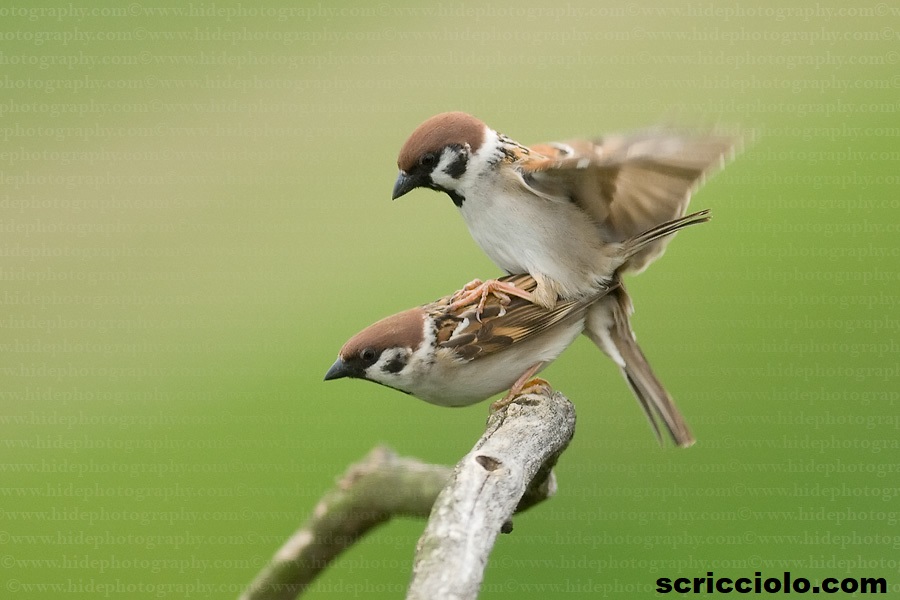
Passer montanus EURASIAN TREE SPARROW. Open woodland,
plains, farms, towns, commensal of man. British Isles and s Scandinavia
e across n Russia and nw, c Siberia to Sea of Okhotsk, Sakhalin and s Kuril
Is. s to n Mediterranean region, Morocco (rarely), nc Turkey, sw Syria,
n,e Iran, Afghanistan, n Pakistan, s Tibet, ne,e India; from Nepal s to
Bangladesh, se Asia, Sumatra, incl. Bangka and Riau Arch., Java, Bali,
China, Taiwan, Korea, Japan and Ryukyu Is. Intro. Canary Is., Pescadores
Is., Borneo, Sulawesi, Philippines, Lesser Sunda Is. of Lombok, Flores,
Sumba, s Moluccas, se Australia, Mariana and Marshall is., c U.S., in c
Missouri, w Illinois and Bermuda (now extirpated).
Passer luteus SUDAN GOLDEN-SPARROW. Thorn savanna,
scrub. Sw Mauritania, n Senegambia, s Mali, Burkina Faso, s Niger,
n Nigeria, n Cameroon, Chad and n,c Sudan to se Egypt and nw Ethiopia and
Eritrea.
Passer euchlorus ARABIAN GOLDEN-SPARROW. Thorn savanna,
scrub. Sw Arabia and n coast of Somalia and Djibouti. Sometimes
considered conspecific with P. luteus.
Passer eminibey CHESTNUT SPARROW. Dry Savanna.
W,s Sudan, c,s Ethiopia and s Somalia s through e Uganda and Kenya to nc,c
Tanzania.
Petronia: Petronias, Rock Sparrow.
Petronia pyrgita YELLOW-SPOTTED PETRONIA. Scrub,
dry savanna, rocks. Locally in s Mali, sw Mauritania, n Senegambia,
s Niger; s Chad, sc,e,se Sudan, Ethiopia, Eritrea and Somalia s to ne Uganda,
Kenya and ne Tanzania. Sometimes treated as a race of P. superciliaris.
Petronia xanthocollis CHESTNUT-SHOULDERED PETRONIA.
Open country, trees, towns. Lowlands to 1200 m from se Turkey, se
Iraq, s,ec Iran and ne Arabia e through Afghanistan, Pakistan and India.
Ranges to Sri Lanka. Sometimes considered conspecific with
P. pyrgita.
Petronia superciliaris YELLOW-THROATED PETRONIA.
Brachystegia woodland, acacia savanna, usually riparian. Gabon, Congo,
s Zaire, Angola, Burundi, c,ne Tanzania, Zambia, Malawi, Mozambique, ne
Namibia, n,e Botswana, Zimbabwe and e,se S. Africa.
Petronia dentata BUSH PETRONIA. Dry woodland, acacia.
S Mauritania, Senegambia, Guinea-Bissau, Sierra Leone, s Mali, n Ivory
Coast, Burkina Faso, s Niger, Ivory Coast, n Ghana, Togo, Benin, Nigeria,
Cameroon, s Chad, n C. African Rep., c,s Sudan, w Ethiopia, Eritrea; sw
Arabia and s Yemen.
Petronia petronia ROCK SPARROW. Stony, rocky slopes
with scrub. Madeira and Canary Is., Spain, Portugal, c,s Italy, s
Balkans, incl. most is. exc. Crete and Cyprus; Morocco to s Tunisia and
nw Libya e through Turkey, Near East s to Israel, Iran, s Russia, n to
se Ukraine, s Russia, n to n Caspian and Aral Seas and s Kazakhstan to
s Siberia, Mongolia and w,c China.
-
Carpospiza brachydactyla PALE ROCKFINCH. Arid regions
with sparse bushy vegetation. Se Turkey, Near East, n Iraq, Iran,
Saudi Arabia, Armenia and s Turkmenia. Nomadic; recorded in Sudan, Ethiopia,
Eritrea and Djibouti. Position and relationships uncertain but usually
regarded as a passerid and placed in Petronia; it is sometimes treated
as a fringillid because of evidence from nesting, eggs and downy nestlings,
but the cranium is "non-cardueline". It is tentatively retained in
the Passerinae.
Montifringilla: Snowfinches.
Gebauer and Kaiser (J. für Orn. 135:55-71, 1994) recommend
placing taczanowskii, davidiana, ruficollis, blanfordi and theresae in
Pyrgilauda. M. nivalis and M. adamsi live year around in rocky habitats
and use rock crevices and rock burrows for roosting and nesting.
They are not associated with small, burrowing mammals, are social and differ
from the other five species in behavior and song. The species of
Pyrgilauda depend on the burrows of small mammals for roosting, breeding
and refuge, can burrow with feet and bill and differ in vocalizations and
behavior from nivalis and adamsi. It is a matter of opinion whether
to recognize one genus or two genera of snowfinches, unless a quantitative
measure of genetic distance can be used.
Montifringilla nivalis WHITE-WINGED SNOWFINCH. Barren
alpine rocky ground, meadows. Locally in mts. to 5200 m in Pyrenees,
Alps, Appennines, Balkans, Turkey, s Russia in Caucasus, s Russia, Turkestan,
sw Sibeia, Iran, n Afghanistan, w Mongolia, w China and Tibet.
Montifringilla adamsi BLACK-WINGED SNOWFINCH. Barren
alpine rocky areas, meadows. Himalayas, 3600-4900 m of w China, Tibet
and extreme n India and n Nepal.
Montifringilla taczanowskii WHITE-RUMPED SNOWFINCH.
Barren alpine rocky areas with colonies of mouse hare (Ochotona).
Himalayas, 4250-5100 of w China and Tibet.
Montifringilla davidiana SMALL SNOWFINCH. Stony plains
with sparse grass, desert edge. Mts. and deserts of s Siberia, Mongolia
and n China.
Montifringilla ruficollis RUFOUS-NECKED SNOWFINCH.
Barren, stony plains, associated with M. taczanowskii but less attached
to mouse hares. Himalayas, 4250-5200 m of w China and Tibet.
Montifringilla blanfordi PLAIN-BACKED SNOWFINCH.
Dry sandy plains with sparse grass, stony areas. Himalayas, 4250-5200
m of w China and Tibet.
Montifringilla theresae AFGHAN SNOWFINCH. Open stony
ground, farmlands. Mts. of n Afghanistan; ranges to s Russia, e Transcaspia.
Subfamily MOTACILLINAE:
Wagtails, Longclaws, Pipits. Usually treated as a separate family
without obvious relatives, but DNA hybridization data indicate that they
are closest to the sparrows and weavers.
-
Dendronanthus indicus FOREST WAGTAIL. Openings and
riparian areas in oak woodland, pine woodland. Lowlands and hills
of se Siberia, Korea and c,e China; ne India.
Motacilla: Wagtails.
Motacilla alba WHITE WAGTAIL. Open country, tundra
to desert edge, shores, often near water, farmlands. Se Greenland,
Iceland, Faroe Is. and n Scandinavia e across n Russia and n Siberia to
Chukotski Pen., s to n Mediterranean region, incl. most is., Turkey, Syria,
s Russia, s Siberia and ne China; w Alaska; n Iran, s Russia, from Transcaspia
e to Turkestan and e Kazakhstan, sw Siberia, n Mongolia, extreme w China,
e Afghanistan and Pakistan.
A complex of related and morphologically distinct forms that overlap
with varying degrees of interbreeding. There is disagreement about
the defining characters and the boundaries of species and subspecies groups.
The subspecies yarrelli interbreeds frequently with alba, whereas interbreeding
with M. lugens, often considered conspecific with M. alba, is restricted.
Some other races may be separate species; e.g., personata and dukhunensis
interbreed freely in some areas but show limited hybridization in others.
Closely related also are
M. grandis, M. madaraspatensis and M. aguimp, all of which are sometimes
considered conspecific with
M. alba.
-
Motacilla lugens BLACK-BACKED WAGTAIL. Open country,
shores, farmlands. China, s Mongolia, se Siberia and Kuril Is. s
to n Pakistan, n India, se Tibet, ne Burma, n Vietnam, s China and n Japan,
n Honshu, sw Alaska on Attu I.
Motacilla grandis JAPANESE WAGTAIL. Open country,
coast, rice paddies, streamsides. Japan, incl. Sado I.
Motacilla madaraspatensis WHITE-BROWED WAGTAIL.
Open country, streams, towns. Lowlands to 1700 m of n Pakistan and
India, n to Himalayan foothills and e to Nepal, Sikkim, Bhutan and Bangladesh.
Motacilla aguimp AFRICAN PIED WAGTAIL. Open country,
farmlands, streamsides. Senegambia, Guinea, Sierra Leone, Liberia,
Ivory Coast, Ghana, Togo, Benin, Nigeria and s Mali e through sw Niger,
Cameroon, Chad, C. African Rep., cs Egypt and s Sudan to Ethiopia, Eritrea
and s Somalia and s in Equatorial Guinea, Gabon, Congo, Zaire, Angola,
Rwanda, Burundi, Uganda, Kenya, Tanzania, Zambia, Malawi, and Zimbabwe
to s Namibia, n,e Botswana, Mozambique and South Africa.
Motacilla capensis CAPE WAGTAIL. Streams, swamps,
farmlands. Highlands from c Angola, and Zaire e to c,w Zambia, Uganda,Rwanda,
Burundi, nw Kenya and sw Tanzania; nw,c Namibia, s Botswana, c Zimbabwe
and s Mozambique s to S. Africa. Apparently closest to M. flava complex
and sometimes included in that group.
Motacilla flaviventris MADAGASCAR WAGTAIL. Open
country, towns, streams. Lowlands to 1800 m of Madagascar.
Motacilla citreola CITRINE WAGTAIL. Wet meadows,
marshes, banks of slow streams, lakes. Locally from ne Russia e to
nc Siberia; from ec Russia, upper Volga R. se to s Siberia and n Mongolia,
thence sw through s Russia, e Kazakhstan, e Turkestan and w,n China to
ne Iran, Afghanistan and Tibet. Occasionally hybridizes with M. flava.
Motacilla flava YELLOW WAGTAIL. Open meadows, marshes,
river banks, seacoasts, fields. Lowlands and hills of Great
Britain and adj. coasts of nw France, Belgium, Netherlands and sw Norway;
Scandinavia e across c Russia to Siberia and s Russia, Kirghiz steppes,
Turkestan, n Caspian and Aral Seas, n Kazakhstan and s to Mauritania and
Mali e to n Algeria, Spain, Portugal, incl. Balearic Is., s France, Alps,
Italy , Sicily and Sardinia, Balkans, Greece, Turkey and Near East, across
s Russia; n Egypt, Nile V.; nw,w,ne China, w,c Mongolia; w,n Alaska.
Variation in this species is complex. Males, especially, differ
greatly in appearance, and there are several regions where two or more
morphological types occur in sympatry with various degrees of intermixing,
but whether they are morphs, intergrading subspecies or sympatric species
is unclear.
M. flava is closely related to M. capensis, M. flaviventris and M.
citreola.
Motacilla cinerea GREY WAGTAIL. Banks of swift streams,
lakes, rarely meadows, seacoast. Hills and mts. from British
Isles, extreme s Scandinavia and cont. Europe e to Poland and w Ukraine
s to Azores, Madeira and Canary Is., Morocco, n Algeria, n Mediterranean
region, incl. most is., and Turkey, thence e across Iran, Afghanistan,
s Russia, s Russia, Transcaspia, Turkestan to w Himalayas, to 4300 m, of
n Pakistan, n India, Kashmir e to c Nepal and probably w China, thence
nw,n through e, nc Russia to Urals and Arctic circle, e across c,s Siberia
to Kolyma R., Kamchatka, Sakhalin and Kuril Is., and s to Mongolia, c,ne
China, Korea and Japan. Closely related to M. clara.
Motacilla clara MOUNTAIN WAGTAIL. Banks of swift
streams in forest. Sierra Leone, Ivory Coast, se Nigeria, sw C. African
Rep., Cameroon and Gabon; highlands from cw,cn,ne Angola, sc,ce,ne Zaire,
w Uganda, w,c Ethiopia and w,c Kenya s through Rwanda, Tanzania, Zambia,
Malawi, Zimbabwe and Mozambique to e S. Africa.
Tmetothylacus tenellus GOLDEN PIPIT. Open arid country,
bushes, small trees. From extreme se Sudan, s,e Ethiopia and Somalia
s to Uganda, c,e Kenya and ne,ce Tanzania. Ranges rarely to Zimbabwe
and ne S. Africa.
-
Macronyx: LONGCLAWS.
-
Macronyx croceus YELLOW-THROATED LONGCLAW. Acacia
thornveld near trees, moist grassland. Senegambia e to Cameroon,
s C. African Rep., s Sudan, Uganda, Kenya and s Somalia and s to nw Angola,
sw,n,ne,ce Zaire, Burundi and e,s Tanzania, thence s through e Zambia,
Malawi, e Zimbabwe and Mozambique to e S. Africa. M. croceus, M.
fuellebornii and M. capensis are closely related.
Macronyx fuellebornii FUELLEBORN'S LONGCLAW. Moist
grassy areas, brachystegia woodland. Angola, exc. nw, extreme n Namibia,
sc,se Zaire, Zambia and sw Tanzania.
-
Closely related to M. croceus and largely allopatric with marginal
sympatry, but with ecological separation in central Angola.
M. capensis is more distantly related and the area of sympatry
is considerably greater, but ecological segregation is usually evident
in areas of overlap.
-
Macronyx capensis CAPE LONGCLAW. Open grassland,
absent from arid areas. E Zimbabwe, extreme s Mozambique, Namibia
and S. Africa in s Transvaal, Swaziland, Natal, Orange Free State, Lesotho,
sw,cn,e Cape Province.
Macronyx flavicollis ABYSSINIAN LONGCLAW. Open grasslands.
Highlands above 1200 m of w,c Ethiopia.
Macronyx sharpei SHARPE'S PIPIT. Open grassy
areas. Mts., 2100-2450 m, of w,c Kenya. Often treated as conspecific
with Macronyx flavicollis. Placed in Anthus by some authors,
including Sibley and Monroe (1990:675). However, the East African
List Committee considers its behavior and vocalizations to be typical of
Macronyx species (D. A. Turner, pers. comm., and Dowsett and Dowsett-Lemaire
1993).
Macronyx ameliae ROSY-THROATED LONGCLAW. Moist,grassy
areas. Locally in wc,cs Kenya and cn Tanzania; from c,ne,cs Angola,
extreme ne Namibia, se Zaire and sw Tanzania s through Malawi, Zambia,
n Botswana and Zimbabwe to w,c Mozambique and e S. Africa.
Macronyx aurantiigula PANGANI LONGCLAW. Arid savanna,
thorn bush. From Somalia s through e,se Kenya to ne Tanzania.
Closely related to M. ameliae; both occur in ne Tanzania but are ecologically
separate.
Macronyx grimwoodi GRIMWOOD'S LONGCLAW. Open wet
grassland. C,e Angola, cs Zaire and extreme nw Zambia.
-
Anthus: Pipits. Species limits in Anthus are
difficult to determine and different species concepts produce different
classifications.
Some authors include widespread populations in a single species (e.g.,
novaeseelandiae), others split them into several species. It should
not be assumed that any given arrangement is final and correct -- widely
allopatric populations may be separate species although they are so much
alike that present evidence cannot distinguish among them. African
forms are especially complex. Dowsett and Dowsett-Lemaire (1993)
and Keith, et al. (1992. Vol. 4. Birds of Africa) include the most recent
treatments. The "species" listed below are those in Sibley and Monroe
(1990) and the quotations from other sources are intended to indicate the
difficulties involved in the taxonomy of this group.
Clancey (1990. Durban Mus. Novitates 15:42-68) resurrected Hemimacronyx
for Sharpe's Pipit and the Yellow-breasted Pipit, considering them
to be intermediate between typical Anthus and Macronyx species. See
note above under Macronyx sharpei. The Yellow-breasted Pipit remains
Anthus chloris.
Dowsett and Dowsett-Lemaire (1993, p. 349) consider A. chloris and
M. sharpei to be "morphologically the most closely related, and place them
next to one another in a systematic list ...." Arctander, et al. (1994.
Ibis, in press) sequenced 1041 bases of the mtDNA cytochrome b gene of
seven species of Anthus with Motacilla alba as the outgroup. Their
results confirm earlier proposals that Berthelot's Pipit is most closely
related to the Tawny Pipit; Richard's Pipit is the next nearest relative
of the Tawny-Berthelot's clade. The Rock and Water pipits are close
relatives, thus supporting other evidence noted below under the species
accounts.
- |